USAID DEC
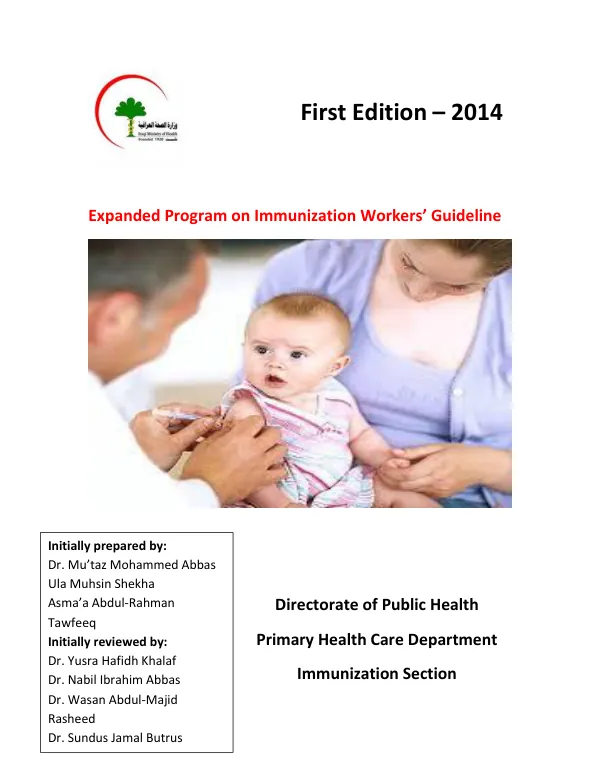
Expanded Program on Immunization Workers’ Guideline
Immunization is a key intervention in improving public health by preventing communicable diseases and reducing morbidity and mortality among all community groups, especially children.
2014 · 64 pages
Sign in to readA free account is required to download.
Abstract
The positive impact of vaccination and its significant outcomes come in line with two other key interventions: provision of safe water and using antibiotics. The concept of vaccination dates back to 1796 when English Scientist Edward Jenner noticed that milkmaids infected with Cowpox did not get infected with smallpox. He scraped pus from cowpox blisters and inoculated a boy, James Phipps, with the virus, which had no effect, and concluded that he now had complete protection against smallpox. The term 'vaccination' was derived from the Latin name of cowpox 'Vaccinia'. The history of vaccine production has been marked by significant achievements. In 1885, French Scientist Louis Pasteur discovered the rabies vaccine, saving lives of people infected with the disease. The production of vaccines against other diseases has also been a major milestone. Diphtheria vaccine was produced in 1923, Pertussis vaccine in 1926, Polio (IPV dead Salk) vaccine in 1955, and Polio (Oral Sabin) vaccine in 1960. Measles vaccine was produced in 1964. Smallpox was eradicated worldwide in 1979, and now all countries seek to eradicate and control other communicable diseases through government health programs and cooperation with international organizations such as WHO and UNICEF. A vaccine is a substance administered to humans to stimulate the immune system to confront and eliminate the causative agent of diseases or their poisons when they enter the human body. Vaccines can be classified into several types, including live, attenuated (weakened), inactivated/killed, and subunit/part of the bacteria. Live, attenuated vaccines contain a weakened form of the bacteria, while inactivated/killed vaccines contain a killed form of the bacteria. Subunit/part of the bacteria vaccines contain only a part of the bacteria, such as the toxin. Poliomyelitis disease is a highly infectious disease caused by the poliovirus. The disease can lead to paralysis, muscle weakness, and even death. The polio vaccine has been instrumental in reducing the incidence of the disease worldwide. The vaccine is available in two forms: the inactivated poliovirus vaccine (IPV) and the oral poliovirus vaccine (OPV). The IPV is given as an injection, while the OPV is given orally. The TB Vaccine (BCG) is a vaccine used to prevent tuberculosis. The vaccine is made from a weakened form of the bacteria that causes TB. The BCG vaccine is given to children at birth or shortly after, and it provides protection against severe forms of TB, such as TB meningitis. The vaccine is also used to prevent leprosy and other diseases caused by the same bacteria. Hepatitis B Vaccine is a vaccine used to prevent hepatitis B, a viral infection that can cause liver disease. The vaccine is made from a weakened form of the virus and is given in a series of injections. The vaccine provides long-term protection against hepatitis B and is recommended for all children at birth. Diphtheria is a bacterial infection that can cause respiratory problems, heart problems, and even death. The diphtheria vaccine is made from a weakened form of the bacteria and is given in a series of injections. The vaccine provides long-term protection against diphtheria and is recommended for all children. Pertussis is a bacterial infection that can cause respiratory problems, including coughing and difficulty breathing. The pertussis vaccine is made from a weakened form of the bacteria and is given in a series of injections. The vaccine provides long-term protection against pertussis and is recommended for all children. Tetanus is a bacterial infection that can cause muscle stiffness, spasms, and rigidity. The tetanus vaccine is made from a weakened form of the bacteria and is given in a series of injections. The vaccine provides long-term protection against tetanus and is recommended for all children. Neonatal tetanus is a form of tetanus that occurs in newborn babies. The disease is caused by the bacteria entering the baby's body through a cut or wound during delivery. The neonatal tetanus vaccine is given to pregnant women to provide protection against the disease. The Expanded Program on Immunization (EPI) has been instrumental in reducing the incidence of vaccine-preventable diseases worldwide. The program has been implemented in many countries and has led to significant reductions in the number of cases of diseases such as polio, measles, and diphtheria. The EPI has also led to improvements in the quality of vaccines and the delivery of vaccination services. Immunization campaigns have been an essential component of the EPI. These campaigns involve the mass administration of vaccines to large populations, often in a short period of time. The campaigns are designed to reach high-risk populations, such as children under the age of five,