USAID DEC
Expanding Access to Quality Child Health and Family Planning Services through Local Medicine Vendors
Sign inUSAID
Expanding Access to Quality Child Health and Family Planning Services through Local Medicine Vendors
The USAID Integrated Health Program (IHP) in Nigeria aimed to strengthen health systems through quality service delivery improvement and scaling up proven cost-effective interventions.
2024 · 13 pages
Sign in to readA free account is required to download.
Abstract
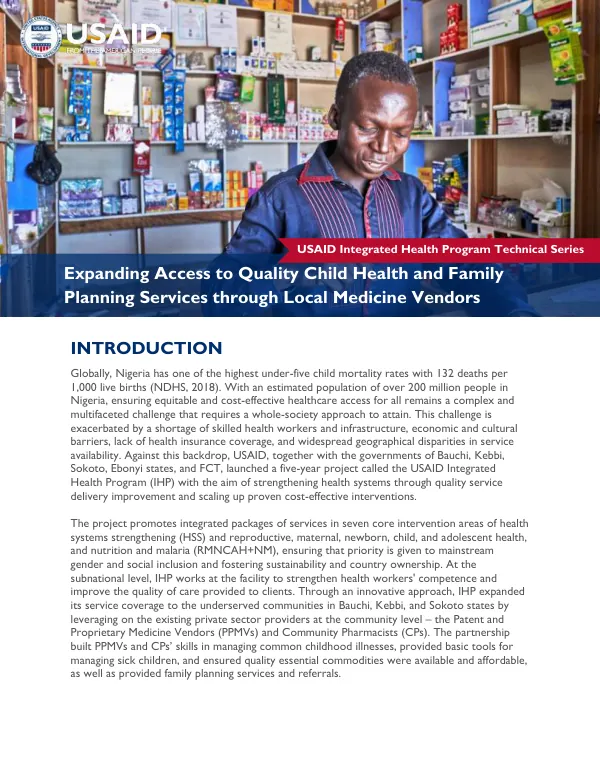
The program focused on seven core intervention areas, including health systems strengthening and reproductive, maternal, newborn, child, and adolescent health, and nutrition and malaria. At the subnational level, IHP worked to strengthen health workers' competence and improve the quality of care provided to clients. IHP expanded its service coverage to underserved communities in Bauchi, Kebbi, and Sokoto states by leveraging existing private sector providers, including Patent and Proprietary Medicine Vendors (PPMVs) and Community Pharmacists (CPs). The partnership built PPMVs' and CPs' skills in managing common childhood illnesses, provided basic tools for managing sick children, and ensured quality essential commodities were available and affordable. Family planning services and referrals were also provided. The Pharmacists Council of Nigeria (PCN) played a key role in regulating and controlling pharmacy education, training, and practice, as well as PPMVs' operations. IHP collaborated with PCN to enhance the capacity of PPMVs and CPs to identify and manage uncomplicated common childhood illnesses and improve access to family planning services and referrals. A total of 1,113 PPMVs and CPs were trained to provide these services. The project also piloted community service delivery data collection and reporting using the Community Health Management Information System (CHMIS) tools. Over 97% of enrolled PPMVs and CPs reported service delivery data. The project expanded coverage and service availability to hard-to-reach communities, with over 145,061 children under five and 31,807 women accessing various services. PPMVs represent a heterogeneous group providing various kinds of health services and commodities in rural settings. They are well-positioned to scale up basic health care services and attain universal health coverage in Nigeria. The Private Sector Landscape Assessment (PSLA) conducted by the USAID-IHP program in 2021 found 582, 387, and 351 licensed PPMVs in Bauchi, Kebbi, and Sokoto states, respectively, while 8,150 are unlicensed in the three states. IHP's objective was to leverage the Task Shifting/Task Sharing (TSTS) policy of the government to train PPMVs and CPs on timely identification and management of uncomplicated common childhood illnesses, improving access to family planning services and products, and referral of pregnant women/newborns and severely ill patients to health facilities for appropriate care. The project aimed to strengthen the capacity of PPMVs and CPs to promptly identify, classify, and treat uncomplicated common childhood illnesses and make referrals. The project also aimed to improve the skills of PPMVs and CPs in their roles and scope in providing family planning services, including informing, screening, refilling/initiating, and referring clients. Additionally, the project aimed to improve their skills in nutrition assessment and counseling, including exclusive breastfeeding, complementary feeding, good hygiene practices, identifying signs and symptoms of malnutrition, and prompt referrals. The project built the capacity of PPMVs and CPs for documenting service delivery data and record-keeping using the Community Health Management Information System (CHMIS).
Related documents