USAID DEC
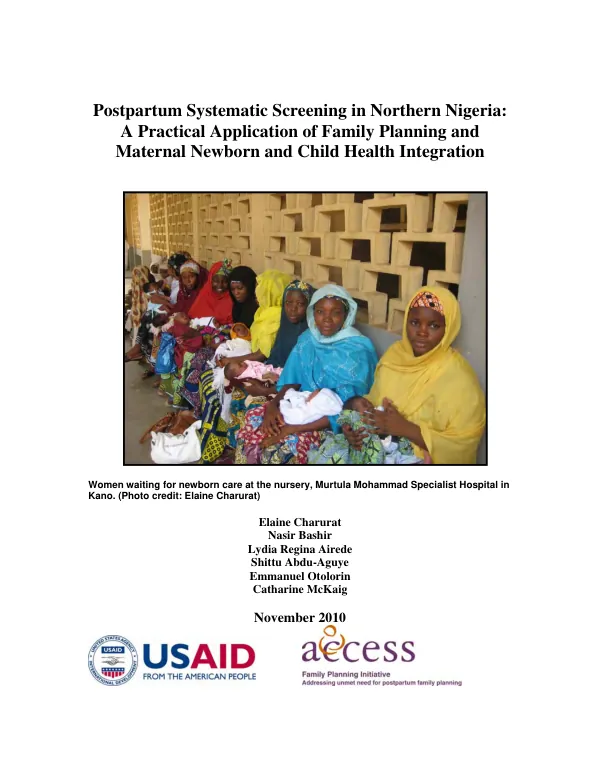
Postpartum Systematic Screening in Northern Nigeria: A Practical Application of Family Planning and Maternal Newborn and Child Health Integration
Sign inPOPULATION COUNCIL
Postpartum Systematic Screening in Northern Nigeria: A Practical Application of Family Planning and Maternal Newborn and Child Health Integration
Systematic screening, a USAID best practice developed by Population Council, is a simple procedure allowing health care providers to address multiple needs of a client during a single visit.
2010 · 30 pages
Sign in to readA free account is required to download.
Abstract
This strategy has been proven successful in operations research in Latin America, Asia, and Africa. With a standardized checklist, health care providers can first identify each client's needs and desires for services, and then provide these services either during the same visit or referrals as needed. In Nigeria, the ACCESS Program transitioned to Maternal and Child Health Integrated Program (MCHIP) in 2009, and has been working in selected local government areas of Kano and Zamfara states since 2006 with the main objective of increasing the use of emergency obstetric and newborn care (EmONC) services, including family planning (FP). The Program is based on the household-to-hospital continuum of care approach for pregnant women, mothers, and newborns. As part of an effort to address the unmet need for FP, especially postpartum family planning (PPFP), MCHIP/Nigeria and ACCESS-FP, in collaboration with the Nigerian Ministry of Health (MOH), piloted postpartum systematic screening. The postpartum systematic screening checklist emphasized screening for postnatal care, antenatal care, family planning (including counseling on postpartum family planning), immunization, and other relevant services. Service providers in immunization, newborn care, and pediatric/sick baby units of the selected hospitals in urban sites in Kano and Zamfara were trained to improve their interpersonal communication, counseling skills, and use of the postpartum systematic screening checklist. The evaluation used pre- and post-intervention approaches and sources of data included observations of provider-client interactions, provider interviews, client exit interviews, and service statistics. With this postpartum systematic screening checklist, clients attending immunization, newborn care, and pediatric/sick baby services were more likely to be screened for FP, postnatal care, and immunization services. In response to high unmet need for FP (88%), the majority (73%) of trained providers knew at least three family planning methods that are suitable for postpartum women, and all of them were providing family planning counseling to pregnant or postpartum women. The results of the evaluation showed that the postpartum systematic screening checklist was effective in increasing service use, particularly postpartum family planning. Clients attending immunization, newborn care, and pediatric/sick baby services were more likely to be screened for FP, postnatal care, and immunization services. The majority of trained providers knew at least three family planning methods that are suitable for postpartum women, and all of them were providing family planning counseling to pregnant or postpartum women. However, few women (15%) said they would go for referrals on the same day. The evaluation also highlighted the importance of training service providers in interpersonal communication, counseling skills, and the use of the postpartum systematic screening checklist. The training also included a contraceptive technology update, which is essential to relevant service providers. The results of the evaluation provide valuable insights into the effectiveness of postpartum systematic screening in increasing service use, particularly postpartum family planning, and highlight the need for continued training and support for service providers.