USAID DEC
Expanding Coverage and Promoting Sustainability of WASH Infrastructure and Hygiene Investments in Madagascar
Sign inPRACTICA FOUNDATION
Expanding Coverage and Promoting Sustainability of WASH Infrastructure and Hygiene Investments in Madagascar
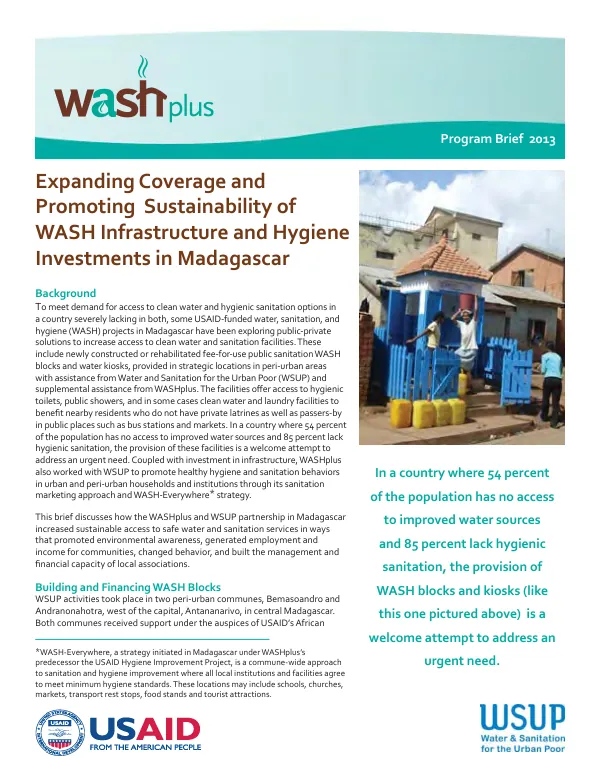
The WASHplus logo is featured prominently in the program brief, highlighting the organization's efforts to expand coverage and promote sustainability of water, sanitation, and hygiene (WASH) infrastructure and investments in Madagascar.
2012 · 4 pages
Sign in to readA free account is required to download.
Abstract
The country faces significant challenges in providing access to clean water and hygienic sanitation options, with 54% of the population lacking improved water sources and 85% lacking hygienic sanitation. To address this urgent need, USAID-funded WASH projects have been exploring public-private solutions to increase access to clean water and sanitation facilities. The WASHplus and Water and Sanitation for the Urban Poor (WSUP) partnership has been instrumental in providing newly constructed or rehabilitated fee-for-use public sanitation WASH blocks and water kiosks in peri-urban areas. These facilities offer access to hygienic toilets, public showers, and clean water and laundry facilities, benefiting nearby residents and passers-by. The partnership has focused on two peri-urban communes, Bemasoandro and Andranonahotra, west of the capital, Antananarivo. WSUP activities have included increasing the sustainability of 21 water kiosks and three WASH blocks constructed under the Cities for the Future (ACF) project. WASHplus provided additional funding to WSUP to construct eight new water kiosks over a six-month period in 2012. The facilities are brightly colored, well maintained, and inviting to users, with several local jobs created to operate each facility. The public-private model implemented by the partnership involves Water User Associations (WUAs), community-based organizations that manage each site, with oversight provided by the commune's WASH Committee. Monthly user fees are set by WUAs, ranging from US$.01 for 20 liters of water to US$.02-.05 for toilet use. Incomes are regularly deposited in microfinance accounts, with revenue from user fees covering fixed and variable running costs in most cases. Capacity building was a critical component of the project, with WASHplus providing technical and capacity building assistance to WSUP. An assessment of WASH sanitation blocks identified constraints and corrective actions for the management of the facilities, with a focus on environmental and sustainability issues. The assessment highlighted the need to motivate customers to abide by operational rules and to provide maintenance and oversight to ensure the facilities' financial viability. Leading a community to healthier habits is a key aspect of the project, with women like Claudine playing a crucial role in promoting WASH messages and behaviors. Claudine, a member of the Valisoa Association and chair of the WASH Committee, has been instrumental in encouraging people in her community to adopt key WASH messages and facilitating the production, sale, and payment of sanitation slabs. Her leadership skills and strong convictions have made her an indispensable figure in the sustainable development process. The partnership's efforts have resulted in increased access to safe water and sanitation services, promoting environmental awareness, generating employment and income for communities, changing behavior, and building the management and financial capacity of local associations. The project's success has been replicated in other areas, with WSUP planning to replicate the best practices in other projects and countries.
Related documents