USAID DEC
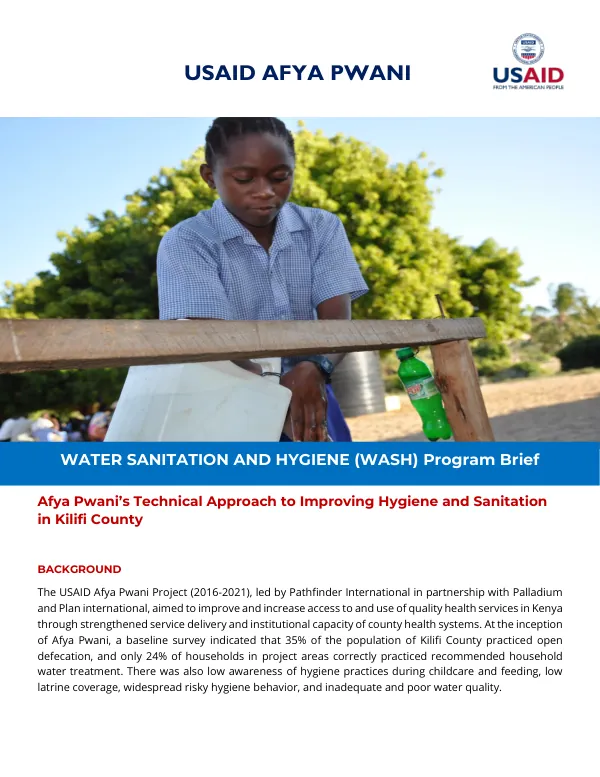
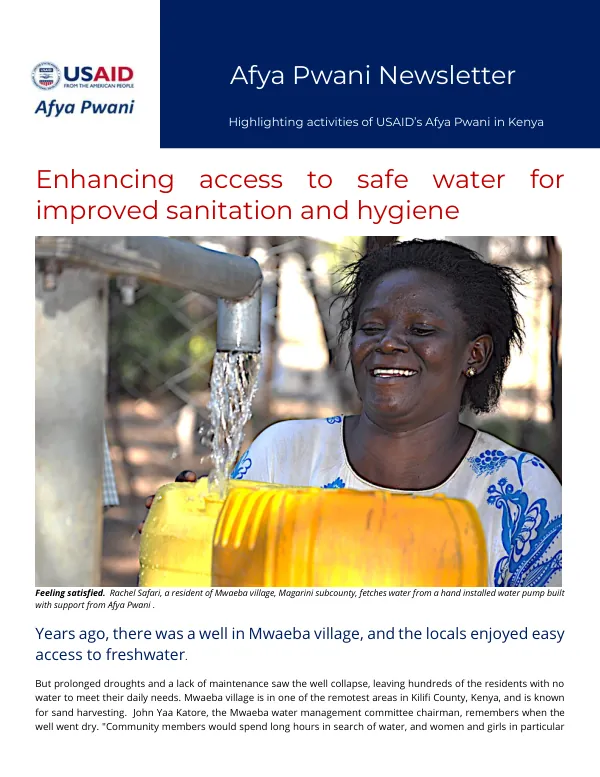
Enhancing access to safe water for improved sanitation and hygiene in Mwaeba village, Kenya
Sign inPALLADIUM INTERNATIONAL, LLC
Enhancing access to safe water for improved sanitation and hygiene in Mwaeba village, Kenya
The USAID-funded Afya Pwani project in Kenya aimed to enhance access to safe water and improved sanitation and hygiene in the Kilifi County region.
2021 · 12 pages
Sign in to readA free account is required to download.
Abstract
The project focused on the Mwaeba village, a remote area known for sand harvesting, where a well had collapsed due to prolonged droughts and lack of maintenance. The community faced significant challenges in accessing clean water, with residents spending long hours searching for water, particularly women and girls. To address this issue, the Afya Pwani project partnered with the County Health Department and implemented a rehabilitation program for the existing hand pump well. The project also trained the community's water management committee on operations and maintenance to prevent future breakages and mismanagement. Additionally, the project promoted water safety through sanitation and hygiene interventions in the community and local institutions, including the Mwaeba primary school and Ngomeni health facilities. The project's water provision efforts included the installation of low-cost water systems, such as roof catchment systems for rainwater harvesting, water pipeline extensions, and connections to schools and healthcare facilities. The project also procured and distributed water treatment chemicals, Purr, and Aqua tabs for water treatment at the point of use. As a result, 21 health facilities and 12 primary schools were installed and connected to water systems, providing access to safe water for 29,037 people in the target areas. The Afya Pwani project also implemented Community-Led Total Sanitation (CLTS) and School-Led Total Sanitation (SLTS) methodologies to promote sanitation and hygiene practices in the community. Through CLTS, the community conducted an appraisal and analysis of open defecation and formulated an action plan to become open defecation-free (ODF). The project trained school health patrons and formed school health clubs to oversee sanitation and hygiene activities in schools. The project's sanitation scale-up efforts included the use of locally available technology, such as Makiga interlocking block-making machines, to construct permanent latrines. The project trained local artisans to manufacture Makiga blocks and invested in the construction of pour-flush toilets, which are simple, safe, and durable. Through the CLTS and sanitation marketing approach, Mwaeba community members increased access to sanitation and hygiene services by constructing latrines and installing tippy tap facilities for handwashing. The project also focused on capacity building, training 452 community resource persons (CORPs) on governance, leadership, management, financial mobilization, group dynamics, conflict resolution, hygiene promotion, CLTS, operation, and maintenance to enhance WASH community project ownership and sustainability. As a result, a total of 26,061 people in the target areas have access to improved sanitation services, and 20 villages have been certified ODF. The project's impact on the community is evident in the improved health and productivity of residents, particularly women and girls. The project's efforts have also led to the establishment of five self-help groups for project sustainability beyond Afya Pwani. The project's success is attributed to its community-led and owned approach, which has empowered residents to take ownership of their water and sanitation systems.