USAID DEC
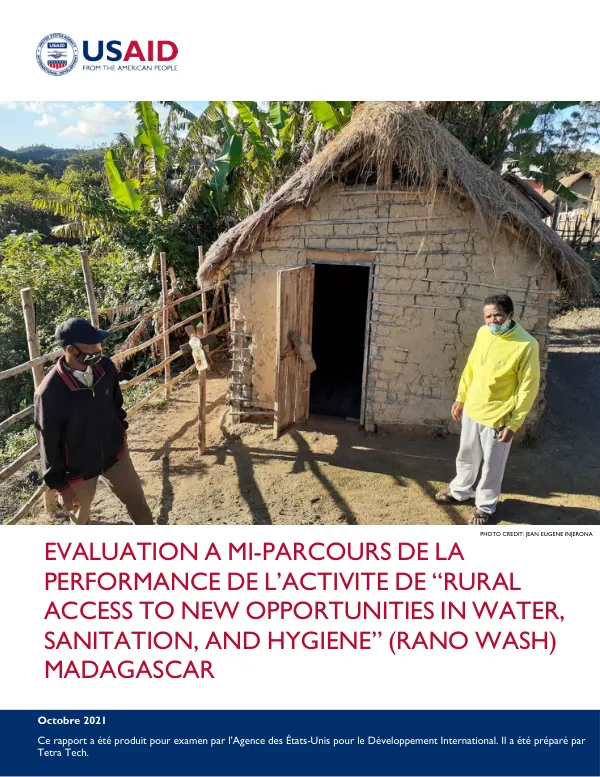
Evaluation a mi-parcours de la performance de l'activite de 'Rural Access to New Opportunities in Water, Sanitation, and Hygiene' (RANO WASH) Madagascar
Sign inTETRA TECH
Evaluation a mi-parcours de la performance de l'activite de 'Rural Access to New Opportunities in Water, Sanitation, and Hygiene' (RANO WASH) Madagascar
The Rural Access to New Opportunities in Water, Sanitation, and Hygiene (RANO WASH) program in Madagascar aimed to improve access to safe water, sanitation, and hygiene (WASH) services in rural areas.
2021 · 134 pages
Sign in to readA free account is required to download.
Abstract
The program was implemented by the Government of Madagascar, with support from the United States Agency for International Development (USAID) and other partners. The program's hypothesis of development was based on the assumption that improved access to WASH services would lead to better health outcomes, increased economic productivity, and improved quality of life for rural communities. To achieve this, the program focused on strengthening the capacity of local governments and communities to manage and maintain WASH services, promoting private sector engagement, and improving access to WASH services for vulnerable populations. The evaluation of the RANO WASH program was conducted by an independent team of experts, led by Carolien van der Voorden, with support from Tetra Tech and the Water, Sanitation, and Hygiene Partnerships and Learning for Sustainability (WASHPaLS) project. The evaluation aimed to assess the program's performance and provide recommendations for future improvements. The evaluation team used a mixed-methods approach, combining both quantitative and qualitative data collection and analysis methods. The team collected secondary data from various sources, including government reports, program documents, and literature reviews. Primary data was collected through key informant interviews, focus group discussions, and surveys with program beneficiaries and stakeholders. The evaluation focused on four key questions: (1) the design of the RANO WASH program, (2) the capacity of local governments and communities to manage and maintain WASH services, (3) the role of the private sector in WASH service delivery, and (4) the demand and utilization of WASH services. The evaluation found that the RANO WASH program had made significant progress in improving access to WASH services in rural Madagascar. The program had increased the number of households with access to improved sanitation facilities, reduced the number of households practicing open defecation, and improved the quality of water sources. The program had also strengthened the capacity of local governments and communities to manage and maintain WASH services, and promoted private sector engagement in WASH service delivery. However, the evaluation also identified several challenges and limitations, including the need for improved coordination and communication among program stakeholders, the need for more effective monitoring and evaluation systems, and the need for increased support for vulnerable populations. Based on the evaluation findings, the team provided several recommendations for future improvements, including the need to strengthen the capacity of local governments and communities to manage and maintain WASH services, the need to promote private sector engagement in WASH service delivery, and the need to improve access to WASH services for vulnerable populations. The team also recommended the development of a more effective monitoring and evaluation system to track program progress and identify areas for improvement. Overall, the evaluation of the RANO WASH program provided valuable insights into the program's performance and identified areas for future improvement. The evaluation findings and recommendations will inform future programming and policy decisions in the WASH sector in Madagascar.
Related documents