ELIZABETH GLASER PEDIATRIC AIDS FOUNDATION
USAID's Implementation Science Investment
The U.S.
2012 · 4 pages
Sign in to readA free account is required to download.
Abstract
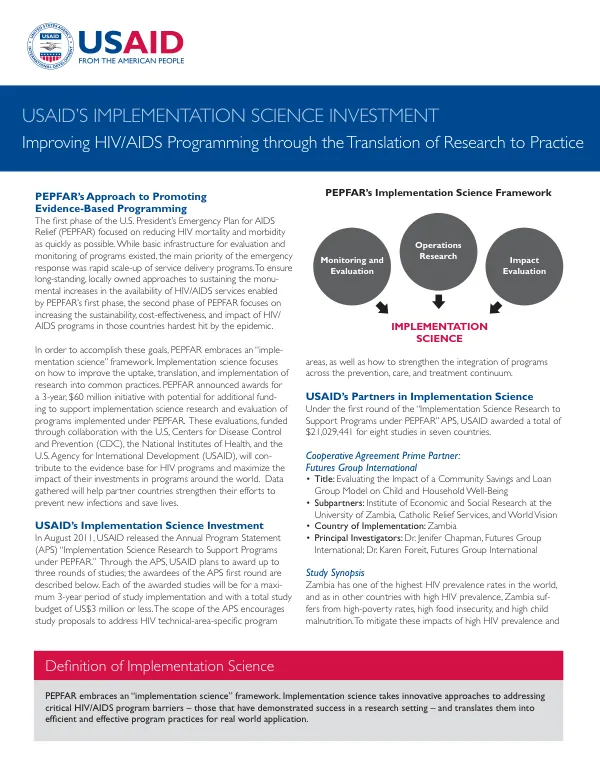
President's Emergency Plan for AIDS Relief (PEPFAR) has undergone a significant shift in its approach to addressing the HIV/AIDS epidemic. The first phase of PEPFAR focused on rapidly scaling up service delivery programs to reduce HIV mortality and morbidity. However, as the emergency response phase came to a close, PEPFAR recognized the need to transition to a more sustainable and locally owned approach to sustaining the increased availability of HIV/AIDS services. To achieve this goal, PEPFAR has adopted an implementation science framework, which focuses on improving the uptake, translation, and implementation of research into common practices. This framework seeks to identify what works, what doesn't, and why, and implement changes in programs to optimize that information. PEPFAR has announced awards for a 3-year, $60 million initiative to support implementation science research and evaluation of programs implemented under PEPFAR. The implementation science investment aims to contribute to the evidence base for HIV programs and maximize the impact of PEPFAR's investments in programs around the world. Data gathered from these evaluations will help partner countries strengthen their efforts to prevent new infections and save lives. The initiative will also support the development of effective approaches to implementing evidence-based practices in HIV/AIDS programs. One of the awarded studies, conducted by the Futures Group International, aims to evaluate the impact of a community savings and loan group model on child and household well-being in Zambia. The study will assess the impact of caregivers' participation in savings and internal lending communities (SILC) on children's food security and examine how participation in SILC changes household decision-making dynamics, children's nutritional status, access to health and school services, and household expenditures. Another study, conducted by the University of Washington, aims to evaluate antiretroviral (ARV)-based prevention in HIV-1 serodiscordant couples in Kenya and Uganda. The study will examine the feasibility and effectiveness of bridging pre-exposure prophylaxis (PrEP) to antiretroviral therapy (ART) in decreasing HIV transmission among HIV serodiscordant couples. A third study, conducted by the International Center for AIDS Care and Treatment Programs (ICAP) at Columbia University, aims to evaluate a combination intervention package to enhance antiretroviral therapy uptake and retention during TB treatment in Lesotho. The study will examine the effectiveness and acceptability of a combination of interventions to improve early ART initiation and retention during TB treatment, as well as TB treatment success among HIV-infected TB patients in Lesotho. A fourth study, conducted by the Elizabeth Glaser Pediatric AIDS Foundation (EGPAF), aims to assess the implementation of revised HIV and infant feeding guidelines and the effect on nutrition, growth, and HIV-free survival among children born to HIV-positive mothers in Kigali, Rwanda. The study will examine the effectiveness of infant feeding practices and the use of ARVs to make extended breastfeeding a safe option for HIV-positive women and children. These studies demonstrate PEPFAR's commitment to improving the effectiveness and sustainability of HIV/AIDS programs in partner countries. By investing in implementation science research and evaluation, PEPFAR aims to contribute to the evidence base for HIV programs and maximize the impact of its investments in programs around the world.