UNITED NATIONS
LEADERSHIP COMMITMENT FORMULATION OF CORE SENIOR MANAGEMENT RESPONSE TOOLS AIDS
Leadership Commitment and HIV/AIDS Issues in Ministry Plans The incorporation of HIV/AIDS issues into Ministry plans is crucial for effective management and mitigation of the epidemic.
4 pages
Sign in to readA free account is required to download.
Abstract
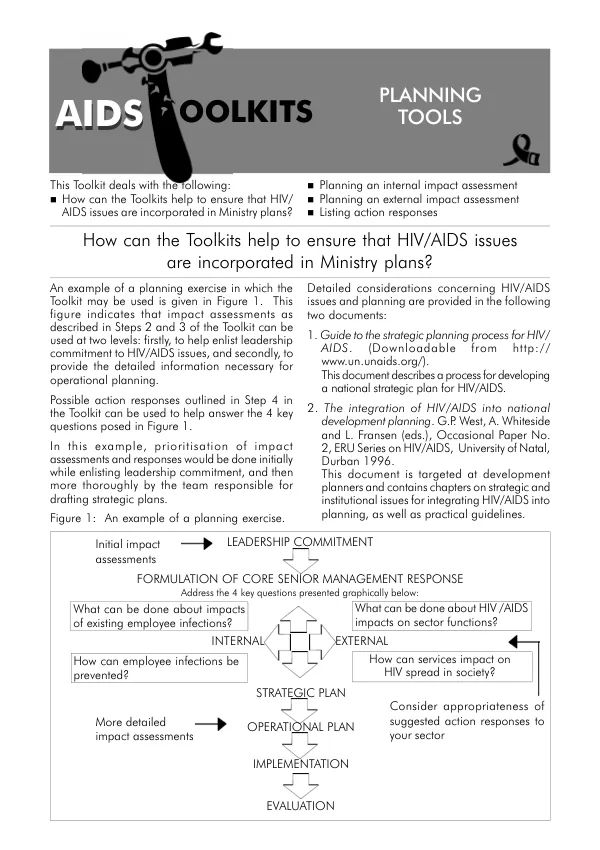
The Toolkits provide a framework for ensuring that HIV/AIDS issues are addressed in Ministry plans. A strategic planning process for HIV/AIDS is described in the Guide to the Strategic Planning Process for HIV/AIDS, which is available for download from the UNAIDS website. The integration of HIV/AIDS into national development planning is also a critical aspect of addressing the epidemic. The document "The Integration of HIV/AIDS into National Development Planning" by G.P. West, A. Whiteside, and L. Fransen provides practical guidelines and strategic and institutional issues for integrating HIV/AIDS into planning. The Toolkits deal with the following aspects of incorporating HIV/AIDS issues into Ministry plans: how the Toolkits can help ensure that HIV/AIDS issues are incorporated into Ministry plans, and an example of a planning exercise in which the Toolkit may be used. The example illustrates the use of impact assessments and possible action responses to address HIV/AIDS issues. Impact assessments are a critical component of the planning process, and they can be used at two levels: to enlist leadership commitment to HIV/AIDS issues and to provide detailed information necessary for operational planning. Possible action responses outlined in the Toolkit can be used to answer key questions posed in the planning exercise. Planning an internal impact assessment involves considering general considerations presented in Step 2 of the sector-specific document. A similar chart to that illustrated in the document can be completed to record initial thinking and suggest ways progress can be monitored. The purpose of the chart is to provide a means of recording initial thinking and to suggest ways progress can be monitored. Examples of possible internal impact assessment requirements include identifying the impact of existing employee infections, the impact of HIV/AIDS on sector functions, preventing employee infections, and preventing the spread of HIV in society. The chart provides a means of recording initial thinking and suggesting ways progress can be monitored. Examples of possible external impact assessment requirements include identifying the impact of HIV/AIDS on the community, the impact of HIV/AIDS on the economy, and the impact of HIV/AIDS on the environment. The chart provides a means of recording initial thinking and suggesting ways progress can be monitored. The incorporation of HIV/AIDS issues into Ministry plans is crucial for effective management and mitigation of the epidemic. The Toolkits provide a framework for ensuring that HIV/AIDS issues are addressed in Ministry plans, and the strategic planning process for HIV/AIDS and the integration of HIV/AIDS into national development planning provide practical guidelines and strategic and institutional issues for integrating HIV/AIDS into planning.