USAID DEC
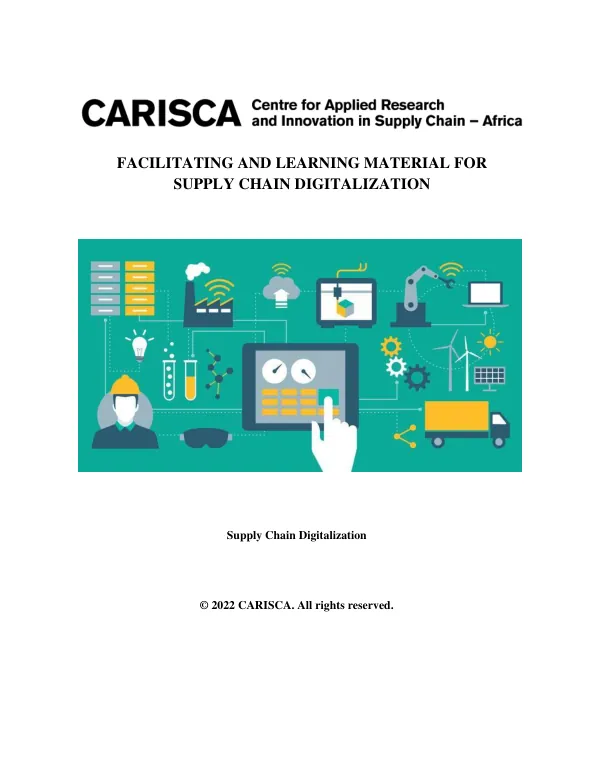
Facilitating and Learning Material for Supply Chain Digitalization
Supply chain digitalization creates opportunities for connecting disparate systems in the supply chain to enable communication within and across organizations to create a single source of truth for information.
2022 · 47 pages
Sign in to readA free account is required to download.
Abstract
Digitized supply chains allow accurate visualization of upstream and downstream supply chain activities, empowering procurement planning and sourcing, and enabling supply chain and logistics teams to collaborate, automate, and effectively leverage data analytics to fulfill customer needs and improve decision making. The digital supply chain network is a key concept in supply chain digitalization. It involves the transformation of supply chains through the use of digital technology, automation, and connectivity along the supply chain. A digital supply chain enables the use of intelligent processes, such as those that connect real-time inventory, customer product interactions, data from delivery services, and Internet of Things (IoT) technologies. Advanced analytics is a crucial component of digital supply chain networks. It involves the use of advanced statistical and mathematical techniques to analyze large datasets and make predictions about future events. Advanced analytics can be used to make decisions regarding manufacturing capacity, raw material costs, future demand, avoiding sales losses, and optimizing inventory. It creates forecasts using what-if studies, data mining, machine learning, and other analytic tools. Digital technologies, including advanced analytics, artificial intelligence, Internet of Things (IoT), and blockchain, are transforming the supply chain landscape. Advanced analytics helps make sense of big data, while artificial intelligence enables systems to comprehend, reason, learn, and interact. IoT involves objects that become "smart" after gateways are installed, allowing them to communicate with other systems directly via the Internet. Blockchain is a publicly accessible database that keeps a constantly growing list of chronological transaction records, making it a trustworthy, secure, quick, and cost-effective way to complete transactions like shipping documents, export documentation, or product tracking. The digital supply chain network is a complex system that requires careful planning and implementation. It involves the use of digital technologies to connect disparate systems and enable communication within and across organizations. The digital supply chain network enables the use of intelligent processes, such as those that connect real-time inventory, customer product interactions, data from delivery services, and IoT technologies. It also enables the use of advanced analytics to make predictions about future events and optimize supply chain operations. The transition to digital supply chains is an evolution rather than a revolution. It involves the gradual adoption of digital technologies and the transformation of supply chain operations. The digital supply chain network is a key component of this transformation, enabling the use of intelligent processes, advanced analytics, and digital technologies to optimize supply chain operations and improve decision making.