USAID DEC
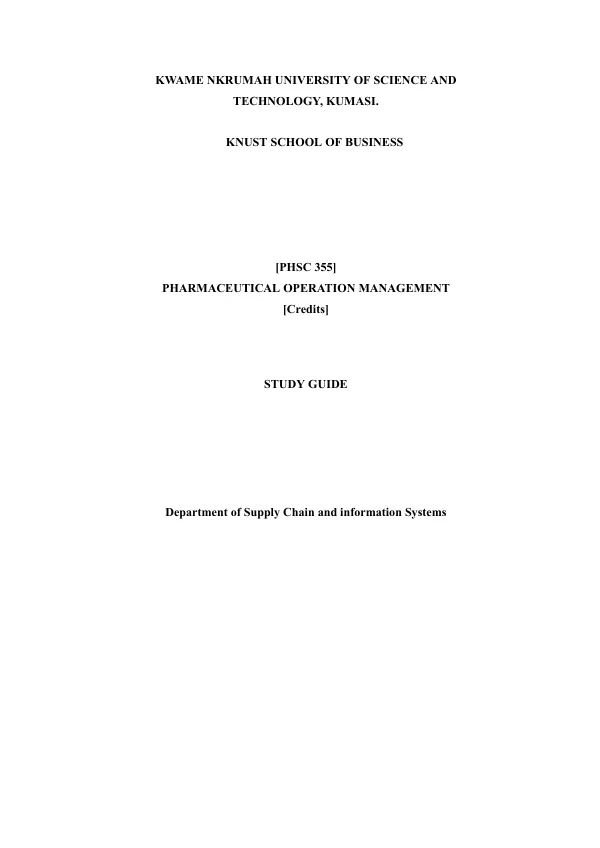
PHSC 355 Pharmaceutical OPERATION MANAGEMENT 2
Operations strategy is a critical component of pharmaceutical operations management, encompassing various activities such as supply and qualification of raw materials, production processes, quality control, logistics, and distribution.
40 pages
Sign in to readA free account is required to download.
Abstract
The term "pharmaceutical operations" refers to the management of these activities under a single umbrella, with the goal of achieving operational excellence. Process management is not a new concept in microeconomics or corporate planning, and it has become increasingly important for businesses to adopt a holistic view of process management. A framework or governance structure is essential for implementing a unique process management approach on an enterprise level. This framework should define global, regional, and local responsibilities, establish modeling and documentation tools, and specify process design and roll-out procedures. Business processes must be both globally oriented and tailored to meet the needs of various groups, including employees, management, business partners, and customers. The course "Pharmaceutical Operations Management" at the KNUST School of Business covers various topics, including operations strategy, pharmaceutical business operations, pharmaceutical manufacturing operations, business process improvement, managing lean production systems, supply chain advanced operations technology, planning, and control, and scheduling, process management, and quality management. The course aims to introduce students to operations management and optimization for a competitive advantage, provide students with an understanding of organizational operational design and implementation, and equip students with strategies for efficiently managing operations. The course requires students to critically apply information learned in the chapters to practical situations, discuss the implications of differences between the production of goods and the delivery of services, and explore ways to improve the consistency and reproducibility of batch production processes. Students are also required to discuss the benefits of comparing process outputs against customer requirements, the importance of achieving defects of less than 3.4 per million opportunities, and the advantages and disadvantages of forward and backward scheduling approaches. The course also covers topics such as vendor relations in lean systems, the importance of matching supply and demand, and the benefits of training Black Belts to run improvement projects. Students are required to draw up schedules indicating the start and finish time for each activity for both forward and backward approaches, discuss the problems created by regularly spaced appointments, and suggest alternative approaches to reduce these problems. The course grading system consists of one group assignment, a mid-semester examination, and an end-of-term examination, with a total of 100% marks. Students are required to exhibit academic and scientific writing skills in their presentations and assignments, following the standards of scientific writing. The course requires students to use Times New Roman font, size 12, 1.5 spacing, and one-inch margins, with a list of references based on the Harvard Style. The course aims to equip students with the knowledge and skills necessary to manage pharmaceutical operations effectively, including operations strategy, business process improvement, and supply chain management. By covering various topics and requiring students to critically apply information learned in the chapters to practical situations, the course prepares students for a career in pharmaceutical operations management.
Related documents