USAID DEC
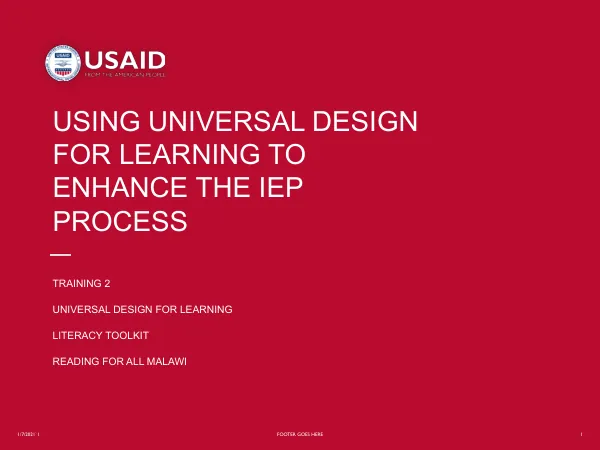
Facilitator Guide for Incorporating UDL into the IEP Process
Universal Design for Learning (UDL) is a framework that guides educators to create inclusive learning environments that cater to the diverse needs of all students.
2021 · 51 pages
Sign in to readA free account is required to download.
Abstract
This framework is based on education, psychology, and brain research, and its primary objective is to support students in learning how to learn, not just the content. UDL is built on the premise that all students can learn, all students learn differently, all students should be supported to learn, and all students do better when learning together. The UDL framework provides a collection of teaching strategies and methods that educators can use to plan their lessons, set up their classrooms, and invite all students to be part of the classroom community. These strategies include planning lessons to include the needs of all learners, setting up classrooms to accept and teach every learner, and using a variety of approaches within each lesson to demonstrate information and skills. Additionally, UDL encourages educators to use a variety of approaches to assess student learning. The connection between UDL and the Individualized Education Program (IEP) is significant. The IEP is a written document that outlines the educational goals and objectives for students with disabilities. UDL can be used to influence decisions on what should be included in the IEP and how it should be implemented. By incorporating UDL principles into the IEP process, educators can create more effective and inclusive plans that cater to the diverse needs of all students. The REFAM IEP Training aims to equip educators with the knowledge and skills necessary to incorporate UDL into the IEP process. By the end of the training, participants will be able to incorporate learnings about UDL into the development of IEPs, successfully participate in the design and implementation of IEPs, and articulate the purpose of the IEP. The training will cover various topics, including the premise of UDL, how to use UDL to influence decisions on what to include in the IEP, and how to implement UDL in the classroom. The training will also focus on the importance of creating a learning environment that promotes learning, helping students access learning more successfully, and articulating the process of setting up an IEP. Participants will learn how to identify and minimize learning barriers, design teaching strategies using UDL, and implement an IEP. By the end of the training, educators will be equipped with the knowledge and skills necessary to create more effective and inclusive IEPs that cater to the diverse needs of all students. The REFAM IEP Training is designed to be a comprehensive and interactive experience that will equip educators with the knowledge and skills necessary to create more effective and inclusive IEPs. The training will cover various topics, including the premise of UDL, how to use UDL to influence decisions on what to include in the IEP, and how to implement UDL in the classroom. By the end of the training, participants will be equipped with the knowledge and skills necessary to create more effective and inclusive IEPs that cater to the diverse needs of all students.