USAID DEC
Chewa Language Assessment for Learners
Assessment of learners in Chichewa language is a crucial process that involves evaluating their skills in reading, writing, and comprehension.
14 pages
Sign in to readA free account is required to download.
Abstract
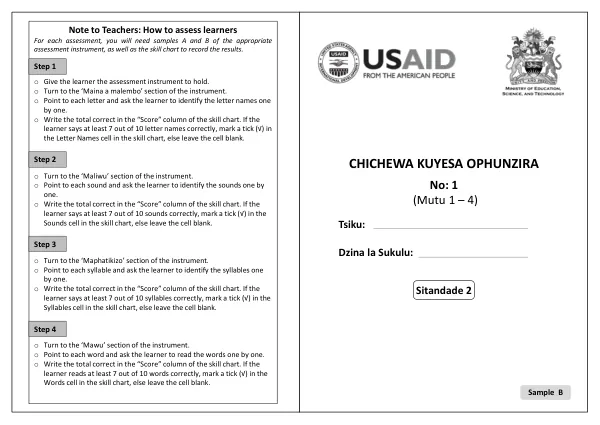
The assessment process typically involves the use of a standardized instrument, which includes sections for identifying letters, sounds, syllables, and words. The assessment instrument is designed to test the learner's ability to identify letters, sounds, and syllables. The learner is presented with a series of letters, sounds, and syllables, and is asked to identify them one by one. The correct responses are recorded in the skill chart, and the learner is considered to have passed if they correctly identify at least 7 out of 10 items in each section. The assessment process typically involves four sections: Maina a Malembo (Letter Names), Maliwu (Sounds), Maphatikizo (Syllables), and Mawu (Words). Each section is designed to test a specific skill, and the learner's performance is evaluated based on their ability to correctly identify the items in each section. In the Maina a Malembo section, the learner is presented with a series of letters and asked to identify their names. The correct responses are recorded in the skill chart, and the learner is considered to have passed if they correctly identify at least 7 out of 10 letter names. In the Maliwu section, the learner is presented with a series of sounds and asked to identify them. The correct responses are recorded in the skill chart, and the learner is considered to have passed if they correctly identify at least 7 out of 10 sounds. In the Maphatikizo section, the learner is presented with a series of syllables and asked to identify them. The correct responses are recorded in the skill chart, and the learner is considered to have passed if they correctly identify at least 7 out of 10 syllables. In the Mawu section, the learner is presented with a series of words and asked to read them. The correct responses are recorded in the skill chart, and the learner is considered to have passed if they correctly read at least 7 out of 10 words. The assessment process is designed to provide a comprehensive evaluation of the learner's skills in reading, writing, and comprehension. The results of the assessment are used to determine the learner's level of proficiency in the Chichewa language and to identify areas where they may need additional support. The assessment instrument is typically used in conjunction with a skill chart, which is used to record the learner's responses and to track their progress over time. The skill chart provides a visual representation of the learner's skills and allows teachers to identify areas where they may need additional support. Overall, the assessment of learners in Chichewa language is an important process that helps to ensure that learners have the skills they need to succeed in school and in life. By providing a comprehensive evaluation of their skills, the assessment process helps to identify areas where learners may need additional support and to provide targeted instruction to help them improve their skills.