USAID DEC
Factors associated with uptake of subdermal contraceptive implants in a young Kenyan population
Sign inFAMILY HEALTH INTERNATIONAL
Factors associated with uptake of subdermal contraceptive implants in a young Kenyan population
Subdermal contraceptive implants may be a reasonable option for young women in sub-Saharan Africa.
2011 · 5 pages
Sign in to readA free account is required to download.
Abstract
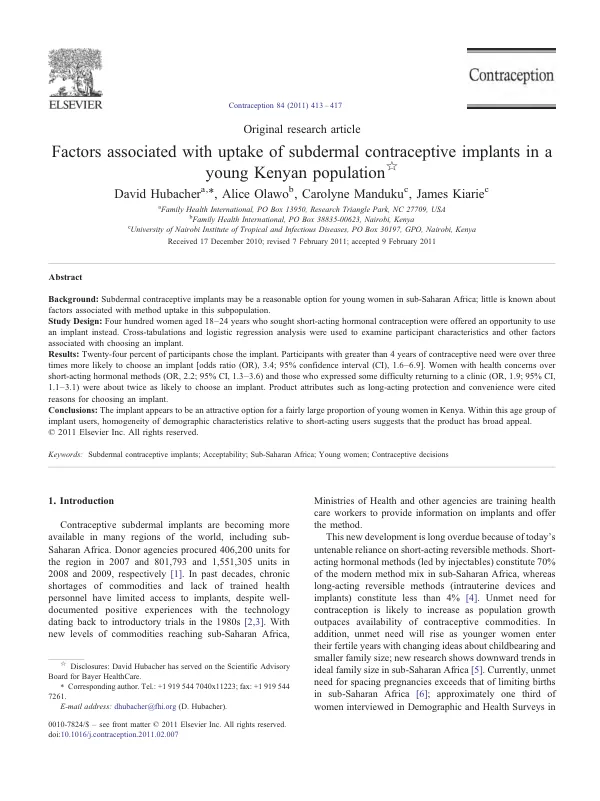
However, little is known about factors associated with method uptake in this subpopulation. To address this knowledge gap, researchers conducted a study at Lang'ata Health Centre in Nairobi, Kenya, between November 2008 and June 2009. The study involved 400 women aged 18-24 years who sought short-acting hormonal contraception. Participants were offered an opportunity to use a subdermal implant instead, and those who chose the implant were asked to provide reasons for their decision. The study found that 24% of participants chose the implant. Logistic regression analysis revealed that participants with greater than 4 years of contraceptive need were over three times more likely to choose an implant. Women with health concerns over short-acting hormonal methods and those who expressed some difficulty returning to a clinic were also about twice as likely to choose an implant. Product attributes such as long-acting protection and convenience were cited as reasons for choosing an implant. The study suggests that the implant appears to be an attractive option for a fairly large proportion of young women in Kenya. Within this age group of implant users, homogeneity of demographic characteristics relative to short-acting users suggests that the product has broad appeal. The study's findings have implications for family planning programs in sub-Saharan Africa. With new levels of commodities reaching the region, Ministries of Health and other agencies are training health care workers to provide information on implants and offer the method. The study's results can inform the development of effective family planning strategies that meet the needs of young women in the region. The study's methodology involved screening women for eligibility and providing them with information about the implant and other contraceptive options. Participants who chose the implant were required to sign a checklist indicating that they understood the advantages and disadvantages of the method. The study used logistic regression to examine factors associated with choosing an implant, including desired length of use, demographic characteristics, and exploratory variables. The study's results suggest that the implant is an attractive option for young women in Kenya, particularly those with greater than 4 years of contraceptive need. The study's findings can inform the development of effective family planning strategies that meet the needs of young women in the region.