JOHN SNOW INTERNATIONAL
Factors limiting immunization coverage in urban Dili, Timor-Leste
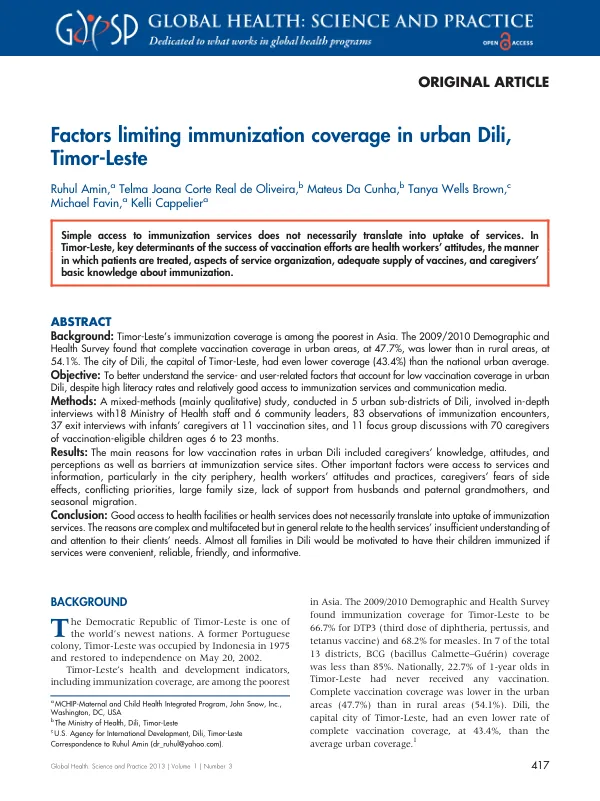
The city of Dili, the capital of Timor-Leste, has one of the lowest complete vaccination coverage rates in the country, with only 43.4% of children fully vaccinated.
2013 · 11 pages
Sign in to readA free account is required to download.
Abstract
This rate is lower than the national urban average of 47.7%. The Dili district has a large population of 234,026, with most residents living in urban areas. The district operates at four levels, with services provided at a national hospital, five referral hospitals, 67 community health centers, and 192 health posts. The Ministry of Health (MOH) has implemented various initiatives to improve immunization services, including enhanced pre-service and refresher training, supportive supervision, and the addition of monthly integrated outreach sessions, known as SISCa. However, despite these efforts, several factors continue to hinder immunization coverage, including minimal community participation, vaccinators' lack of interpersonal communication skills, and deficient routine data recording and reporting. The Expanded Programme on Immunization (EPI) has made significant progress in Timor-Leste since the country emerged from decades of turmoil in 1999, but issues with immunization coverage and quality persist. The study aimed to identify the key factors contributing to low immunization coverage in urban Dili. A cross-sectional, mixed-methodology study was conducted in March and April 2012, combining qualitative and quantitative methods, including observations, exit interviews, in-depth interviews, and focus group discussions. The study population consisted of caregivers of children ages 6 to 23 months, health staff members, and community leaders. A total of 83 immunization encounters were observed, and 37 exit interviews were conducted with caregivers. The findings of the study revealed that caregivers' knowledge, attitudes, and perceptions, as well as barriers at immunization service sites, were the main reasons for low vaccination rates in urban Dili. Other important factors included access to services and information, particularly in the city periphery, health workers' attitudes and practices, caregivers' fears of side effects, conflicting priorities, large family size, lack of support from husbands and paternal grandmothers, and seasonal migration. The study also found that good access to health facilities or health services does not necessarily translate into uptake of immunization services. The reasons for this are complex and multifaceted, but in general relate to the health services' insufficient understanding of and attention to their clients' needs. The study's findings have implications for improving immunization services in urban Dili. The Dili District Health Services and partners can use the study's recommendations to devise effective and feasible solutions that would improve immunization services, reduce dropout rates, and increase coverage. The study suggests that modifications to service availability, provider practices, community mobilization, and/or health promotion could improve vaccination coverage.