BURNET INSTITUTE
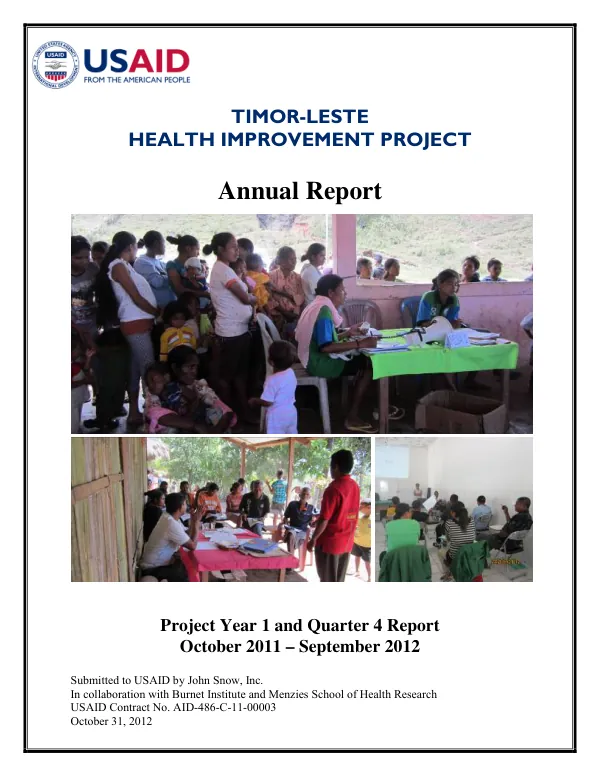
Timor-Leste Health Improvement Project Annual Report PY1 and Q4 2012
The Health Improvement Project (HIP) in Timor-Leste aims to improve maternal, newborn, and child health behaviors and outcomes, as well as increase community engagement around key health issues.
2012 · 64 pages
Sign in to readA free account is required to download.
Abstract
The project is a four-year initiative implemented by John Snow, Inc. (JSI) in collaboration with the Ministry of Health (MOH) and other partners. The project objectives are to improve maternal, newborn, and child behaviors and outcomes, improve health service delivery through MOH service delivery sites, and increase community engagement around key health issues. The project focuses on three technical areas: Maternal and Newborn Health (MNH), Child Health, and Family Planning (FP). HIP activities are concentrated in five priority districts: Oecusse, Manatuto, Ermera, Baucau, and Viqueque. The project targets three population segments: health providers at the district, sub-district, and community levels; women of reproductive age; and children under five years of age. The project incorporates six years of lessons learned from previous USAID-supported projects in Timor-Leste, focusing on health systems strengthening, infectious disease prevention, nutrition, food security, maternal and child health, and family planning programming. HIP activities are guided by the following cross-cutting operational and implementation themes: gender equity, promotion and support of Timorese organizations, and coordination with other development partners. In the first year of the project, HIP has made significant progress in implementing its activities. The project has established working groups with MOH and other partners to improve service quality, quality and use of management information, and community-level services. HIP has also conducted training sessions for health providers on integrated management of childhood illnesses (IMCI) and family planning. The project has achieved notable results in improving health service delivery and community engagement. According to the project's quarterly progress report, the number of service delivery points (SDPs) supervised during the fourth quarter increased by 15% compared to the previous quarter. The project has also supported the implementation of the Family Health Register (RSF) in all five priority districts, with a 90% completion rate. In addition, HIP has made progress in improving community-level services and behaviors. The project has supported the establishment of 15 community health centers (CHCs) and 20 health posts, which have increased access to health services for rural communities. The project has also conducted training sessions for community health workers on maternal and child health and family planning. The project's monitoring and evaluation (M&E) system has been established, and data collection and analysis are ongoing. The project has also conducted a midterm evaluation, which has provided valuable insights into the project's progress and areas for improvement. Overall, the Health Improvement Project in Timor-Leste has made significant progress in its first year, achieving notable results in improving health service delivery and community engagement. The project's activities are guided by a strong commitment to gender equity, promotion and support of Timorese organizations, and coordination with other development partners.
Related documents