USAID DEC
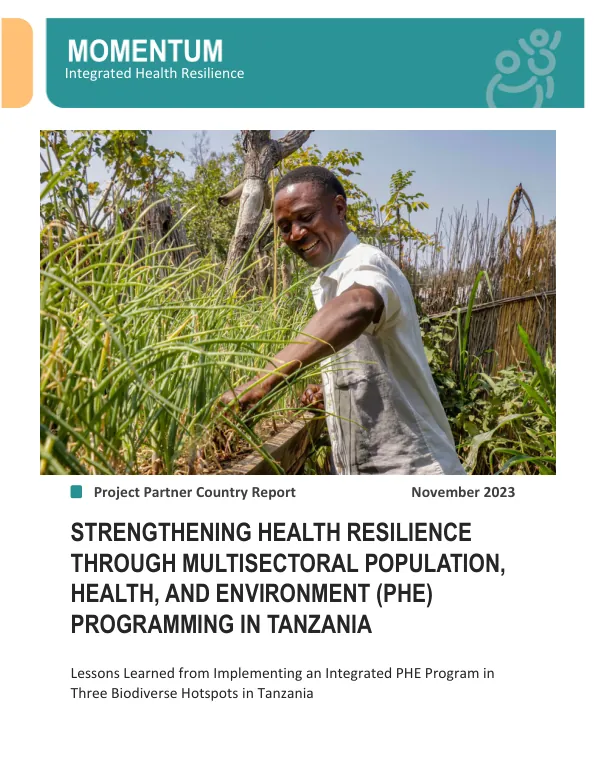
Strengthening Health Resilience Through Multisectoral Population, Health, and Environment (PHE) Programming in Tanzania
Sign inAFRICAN CHRISTIAN HEALTH ASSOCIATION PLATFORM
Strengthening Health Resilience Through Multisectoral Population, Health, and Environment (PHE) Programming in Tanzania
Tanzania experiences a range of interconnected environmental challenges, including biodiversity loss, poor natural resource management, and climate change.
2023 · 17 pages
Sign in to readA free account is required to download.
Abstract
According to the Notre Dame Global Adaptation Initiative (ND-GAIN) index, Tanzania is considered to have high vulnerability and low readiness to cope with and adapt to climate change. The country is already experiencing negative effects from climate change, including an increase in the frequency and severity of droughts and reduced quality and quantity of fresh water. Temperatures are projected to rise, and wet and dry periods are likely to become more extreme. These interconnected environmental challenges interact with each other and other social and health outcomes in ways that threaten the resilience of communities, highlighting the need for an integrated approach. The MOMENTUM Integrated Health Resilience program is implementing an integrated, multisectoral Population, Health, and Environment (PHE) approach to address these complex and interconnected challenges and help strengthen health resilience. Three specific approaches in this PHE model are the Model Household/Boma Initiative, First-Time Parents program, and Community Conservation Microfinance Groups, which are all implemented to holistically address the interaction between health and environment at household and community levels. These include lack of latrine use, unsafe water supply, overfishing, and resistance to voluntary family planning. Health Resilience is the ability of people, households, communities, systems, and countries to mitigate and adapt to shocks and stresses in a manner that reduces acute and chronic vulnerabilities and facilitates equitable health outcomes. Population, health, and environment (PHE) strategic approaches aim to simultaneously improve access to health services while helping communities manage natural resources in ways that allow them to improve their livelihoods and conserve biodiversity. PHE activities are by definition multisectoral and incorporate a variety of sexual and reproductive health and rights, natural resource management, and biodiversity conservation objectives and actions. MOMENTUM's community-oriented PHE efforts in Tanzania tap into non-health-related partnerships with conservation nongovernmental organizations for the implementation of an integrated, multisectoral approach that includes maternal, newborn, and child health; sexual and reproductive health and rights (SRHR); conservation; and livelihoods programming. The project focuses on strengthening health resilience, including to the impacts of climate change, and places women and girls at the center of the project's PHE programming to support communities in becoming more equitable, healthy, and sustainable. The three specific interventions highlighted in this report were selected to serve as a snapshot of the broader MOMENTUM Integrated Health Resilience PHE program activities in Tanzania that are being implemented in close partnership with The Nature Conservancy, the Southern Tanzania Elephant Programme, the Government of Tanzania, and others. Through these partnerships, the project is able to leverage the expertise and programming experience of health and conservation partners and jointly design and implement a package of interventions that holistically address the needs of communities within the three geographic landscapes where MOMENTUM works. The first activity, Model Households/Boma Initiative, aims to promote sustainable livelihoods and improve health outcomes in rural communities. The initiative focuses on promoting the use of latrines, improving water quality, and reducing the use of firewood for cooking. The second activity, First-Time Parents program, aims to improve maternal and child health outcomes by providing education and support to first-time parents. The program focuses on providing information on reproductive health, nutrition, and child care, as well as providing support for breastfeeding and postnatal care. The third activity, Community Conservation Microfinance Groups, aims to promote sustainable natural resource management and improve livelihoods in rural communities. The program focuses on providing microfinance loans to community members to support sustainable agriculture and conservation activities.
![MOMENTUM INTEGRATED HEALTH RESILIENCE [Tanzania PY3 Q2] Performance Report](https://covers.devme.ai/gen/148192.webp)