GOVERNMENT OF INDONESIA
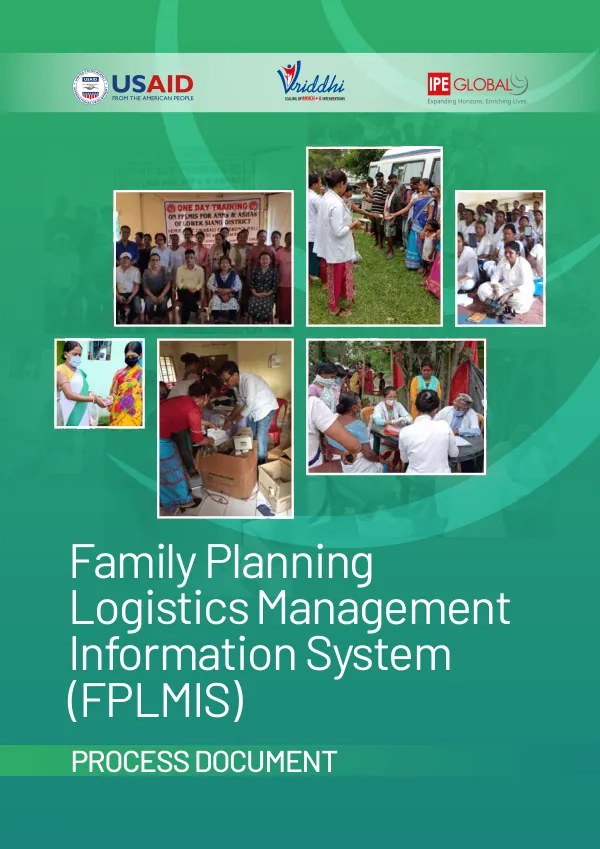
Family Planning Logistics Management Information System (FPLMIS) Process Document
The Family Planning Logistics Management Information System (FPLMIS) is a system designed to ensure effective, efficient, and uniform management of family planning commodities across India.
2021 · 58 pages
Sign in to readA free account is required to download.
Abstract
The system aims to improve the access to family planning commodities by establishing a robust supply chain management system at all levels, from national to household. The Indian public health system follows a centralized contraceptive procurement system managed by the Ministry of Health & Family Welfare (MoHFW) at the national level. However, the manual supply chain management system had several limitations, including a push mechanism from top-down that did not account for actual need or demand of consumers, leading to overstocking and expired goods. Additionally, there was a lack of skills of personnel on demand forecasting, inventory management, and distribution processes, resulting in stock outs. The system also involved exhaustive paperwork for a simple process of indenting and receiving supplies, and lacked an effective decision-making tool. To address these limitations, the Government of India, with technical support from USAID through the Vriddhi project, initiated capacity building of health functionaries responsible for supply management of FP commodities in 10 states of India. The technical support was provided through all the steps of implementation, starting from mapping of FPLMIS users to training and indenting. Administrative support was also provided in the form of additional personnel at the national and state level who had distinct roles and responsibilities. The Vriddhi personnel worked in tandem with the state government counterparts to come up with a mapping and training plan, along with operationalization of FPLMIS. Monitoring and handholding were provided at all the junctures in the supply channel, including forecasting, procurement, indent, storage, and distribution. An automated tracking sheet was created to help identify facilities and levels that were performing below state average, so that action could be taken. Regular review meetings were conducted at the state and district levels to highlight FPLMIS data and develop an action plan for underperforming levels with a timeline for improvement. Team coordinators also conducted regular visits in each of the intervention states to share progress, steer advocacy at the directorate level for FPLMIS issues resolution, and plan activities for state consultants. The Vriddhi team maintained regular contact with CDAC on bugs in the system and recommended changes to make it more robust. With the onset of the pandemic, alternate modes of conducting reviews and trainings were adapted, which turned out to be expedient for states like Arunachal Pradesh, Mizoram, and Nagaland. The percentage of trainings and indenting increased substantially compared to the period before the pandemic. So far, a total of 1,87,135 users have been mapped, which is 74% of the total available users. Out of this, 29% have started indenting. 100% district warehouse of all the states has been mapped, and all of them have started indenting. 100% CHC, other facilities, and DH across all the 10 states have been mapped, of which 84.7% have started indenting. More than 90% and 70% ANM and ASHA have been mapped, respectively, with 62% ANM indenting. Out of the total mapped users, 5,828 (90%) health facilities, 19,936 (76%) ANM, and 42,365 (26%) ASHA have been trained on FPLMIS. As a way forward, completion of remaining activities, transferring MIS and training tools to the states, and advocating for PIP commitment of necessary human resource are critical to ensure sustainability of Vriddhi's efforts toward implementation.
Related documents