USAID DEC
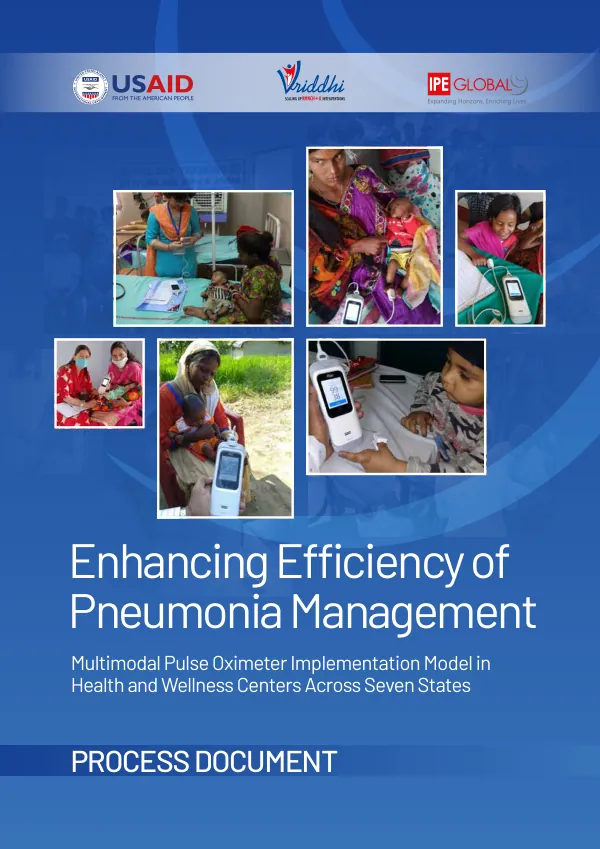
Enhancing Efficiency of Pneumonia Management: Multimodal Pulse Oximeter Implementation Model in Health and Wellness Centers Across Seven States
Sign inGOVERNMENT OF INDONESIA
Enhancing Efficiency of Pneumonia Management: Multimodal Pulse Oximeter Implementation Model in Health and Wellness Centers Across Seven States
The USAID Vriddhi project is supporting the Government of India to strengthen the Reproductive, Maternal, Newborn, Child, and Adolescent Health (RMNCH+A) program in aspirational districts of seven project states.
2021 · 22 pages
Sign in to readA free account is required to download.
Abstract
The project aims to enhance pneumonia management in primary health care settings through the introduction of a multimodal pulse oximeter. The device is capable of recording respiratory rate in children, addressing the challenges of misclassification of pneumonia due to manual counting of respiratory rate. The project partnered with Masimo, a US-based company, to test the efficacy of the multimodal device in pneumonia identification, usability, and scalability using the Integrated Management of Neonatal and Childhood Illness (IMNCI) platform. The device was selected and validated in a Delhi hospital before initiation of baseline assessments in seven states for selection of facilities as per intervention criteria and collection of baseline data on current practices. The intervention was rolled out in 19 Health and Wellness Centers (HWCs) of 12 Aspirational Districts across the seven project states in July 2019. One device was donated to each HWC, and the staff were trained using a three-day adapted IMNCI package. The staff were also trained on the use of the device for screening of pneumonia in under-five children presenting with Acute Respiratory Infection (ARI) fever. The intervention has been successfully running in the intervention sites with no case of discontinuation of the pulse oximeter and no breakdown of the pulse oximeter reported till date from any of the sites. A qualitative assessment to measure acceptability and robustness of the pulse oximeter reported a high degree of acceptability by providers, reducing unnecessary referrals while enabling timely referrals for those children requiring oxygen therapy. Program data supports the findings, with antimicrobial use rate at 26% and correct use in 81% of cases with fast breathing or chest in-drawing or other serious conditions. Referral of 1% was correctly made of 77.5% cases with SpO2<90 or general danger signs or other valid conditions. Correct case management was observed in 91.4% children with ARI symptoms. Pneumonia is the leading cause of deaths among children under-five across the globe, killing around 1.4 million children worldwide every year. In India, pneumonia is the single most important cause of death among children in the post-neonatal period, contributing to 15 percent of under-five deaths annually. The Government of India's aspirational districts program aims to quickly and effectively transform backward districts by strengthening and accelerating improvement in health indicators along with other development indicators. The World Health Organization (WHO) IMNCI guidelines recommend counting of respiratory rate for one minute, checking hypoxemia (SpO2), and looking for danger signs and chest in-drawing for case management of pneumonia. A recent study in Malawi confirmed the utility of pulse oximetry in Primary Health Care (PHC) settings, reporting a two-fold increase in referrals for children having a low SpO2. Counting RR is a challenge and often leads to misclassification even by trained healthcare workers, while chest in-drawing is not adequately recognized.
Related documents