USAID DEC
Family Planning: What and Why?
Family planning is a crucial aspect of reproductive health that involves making informed decisions about the timing and spacing of pregnancies.
18 pages
Sign in to readA free account is required to download.
Abstract
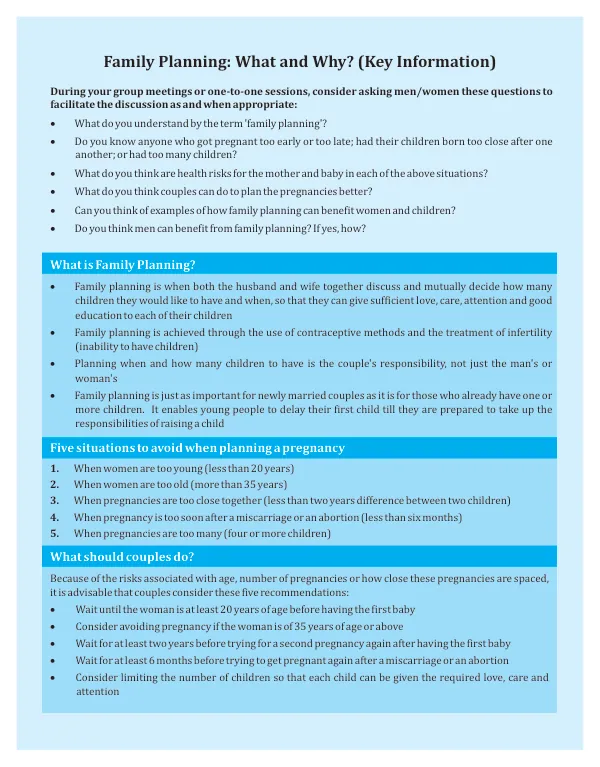
It is a joint responsibility of both partners, and its importance cannot be overstated. Family planning enables couples to have control over their reproductive lives, allowing them to make choices that are best for their health, well-being, and financial stability. Five situations to avoid when planning a pregnancy include having a child when the woman is too young (less than 20 years), too old (more than 35 years), or when pregnancies are too close together (less than two years difference between two children), too soon after a miscarriage or an abortion (less than six months), or when pregnancies are too many (four or more children). These situations can lead to various health risks for both the mother and the baby. To avoid these situations, couples can consider the following recommendations: waiting until the woman is at least 20 years of age before having the first baby, avoiding pregnancy if the woman is of 35 years of age or above, waiting for at least two years before trying for a second pregnancy again after having the first baby, waiting for at least six months before trying to get pregnant again after a miscarriage or an abortion, and considering limiting the number of children so that each child can be given the required love, care, and attention. Family planning has numerous benefits for the mother, including being able to breastfeed longer, which reduces the risk of breast and ovarian cancer, and being at a lower risk of dying from complications during pregnancy and childbirth. It also allows the mother to get more time to take care of the baby, be physically, emotionally, and financially prepared for her next pregnancy, and have more time for herself, her children, husband, and participate in educational, economic, and social activities. For the children, family planning benefits include being more likely to be born strong and healthy, getting more attention and care from their parents, and being breastfed for a longer period of time, which allows them to reap the benefits of breastfeeding, including better nutrition, protection from childhood diseases, and attention from the mother. For the father, family planning benefits include feeling an increased sense of satisfaction from safeguarding the health and well-being of his wife and children, having more time between births, allowing him time to plan finances before the next child, and having more time for his wife, which will contribute to a better relationship. For the entire family, family planning contributes to financial security because a smaller, well-spaced family helps families spend less money and build up savings over time, makes education for the children more affordable, and reduces maternal and child illnesses, allowing money that would otherwise be used on their treatments to be used for constructive purposes. In terms of contraceptive methods, there are various options available to couples, including condoms, pills, LAM, SDM, injectables, IUD (Copper-T), and female sterilization or tubectomy. The choice of method depends on several factors, including the couple's family planning goals, the effectiveness of the method, ease of use, willingness to tolerate possible side effects, cost, and ease of acquiring and how often the couple will need to visit the health center. Condoms are a popular contraceptive method that offers protection against pregnancy and STIs/HIV. They are easy to use, widely available at low cost or for free, and have no side effects or health risks. However, they must be used every time the couple has sexual intercourse to prevent a pregnancy, and there is a small possibility that the condom might slip off or break during sexual intercourse. In conclusion, family planning is a vital aspect of reproductive health that enables couples to make informed decisions about the timing and spacing of pregnancies. It has numerous benefits for the mother, children, father, and the entire family, and there are various contraceptive methods available to couples. By understanding the importance of family planning and the available contraceptive methods, couples can make informed choices that are best for their health, well-being, and financial stability.