JHPIEGO
Role-play situations for Family Planning Service Providers
Family Planning Services for Women of Reproductive Age The primary goal of family planning services is to provide women with the necessary information and resources to make informed decisions about their reproductive health.
2016 · 1 pages
Sign in to readA free account is required to download.
Abstract
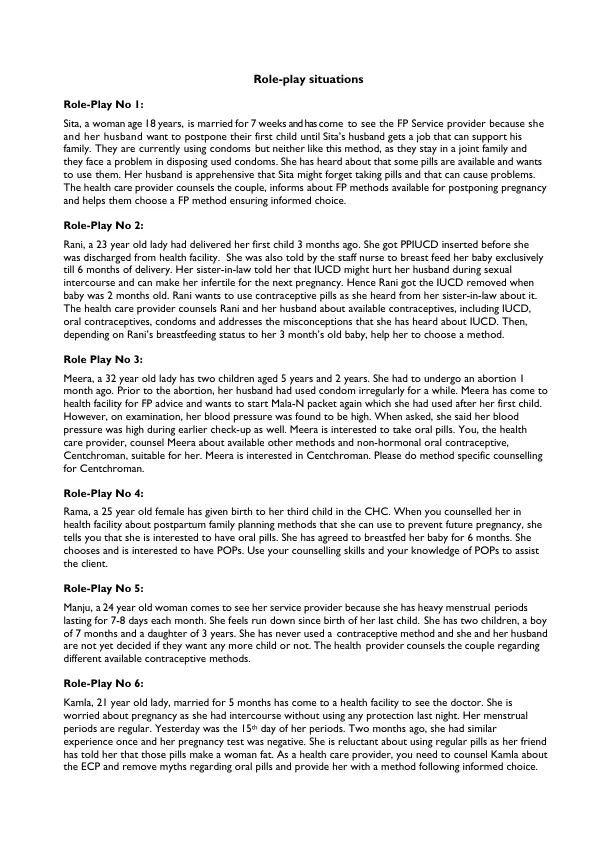
This includes access to a range of contraceptive methods, counseling, and education on reproductive health. In the context of family planning, counseling plays a crucial role in empowering women to make informed choices about their reproductive health. A recent study found that women who received comprehensive counseling on family planning options were more likely to choose a method that met their needs and preferences. One of the key challenges in family planning is addressing misconceptions and myths about contraceptive methods. For example, some women may believe that certain methods, such as intrauterine devices (IUDs), can cause infertility or other health problems. In reality, IUDs are a highly effective and safe form of contraception that can be used by women of all ages. Another challenge in family planning is addressing the needs of women who are breastfeeding. Breastfeeding is an essential aspect of a woman's reproductive health, and it is essential to provide women with information on the safety and effectiveness of different contraceptive methods while breastfeeding. In terms of contraceptive methods, there are a range of options available to women, including hormonal and non-hormonal methods. Hormonal methods, such as oral contraceptives and injectables, can be highly effective in preventing pregnancy, but they may not be suitable for all women, particularly those who are breastfeeding. Non-hormonal methods, such as condoms and IUDs, are also highly effective and can be used by women of all ages. However, some women may experience side effects or have concerns about the use of these methods. In addition to providing women with information on contraceptive methods, family planning services also play a crucial role in addressing the social and cultural factors that influence reproductive health. For example, some women may face pressure from their families or partners to have children, while others may experience stigma or discrimination related to their reproductive choices. Ultimately, the goal of family planning services is to provide women with the autonomy and agency to make informed decisions about their reproductive health. By providing women with access to comprehensive counseling, education, and resources, family planning services can help to empower women to take control of their reproductive health and make choices that are best for them. In the context of the role-plays provided, the following key points emerge: * Women's reproductive health is influenced by a range of social, cultural, and economic factors. * Counseling plays a crucial role in empowering women to make informed decisions about their reproductive health. * Misconceptions and myths about contraceptive methods can be a significant barrier to women's access to family planning services. * Breastfeeding is an essential aspect of a woman's reproductive health, and it is essential to provide women with information on the safety and effectiveness of different contraceptive methods while breastfeeding. * Non-hormonal methods, such as condoms and IUDs, are highly effective and can be used by women of all ages. * Family planning services can help to address the social and cultural factors that influence reproductive health and empower women to take control of their reproductive health. In terms of the specific role-plays, the following key points emerge: * Role-Play No. 1 highlights the importance of counseling in empowering women to make informed decisions about their reproductive health. * Role-Play No. 2 highlights the need to address misconceptions and myths about contraceptive methods, such as IUDs. * Role-Play No. 3 highlights the importance of providing women with information on non-hormonal contraceptive methods, such as Centchroman. * Role-Play No. 4 highlights the need to provide women with information on the safety and effectiveness of different contraceptive methods while breastfeeding. * Role-Play No. 5 highlights the importance of addressing the social and cultural factors that influence reproductive health, such as the pressure to have children. * Role-Play No. 6 highlights the need to provide women with information on emergency contraceptive pills (ECPs) and address misconceptions and myths about oral contraceptives.