USAID DEC
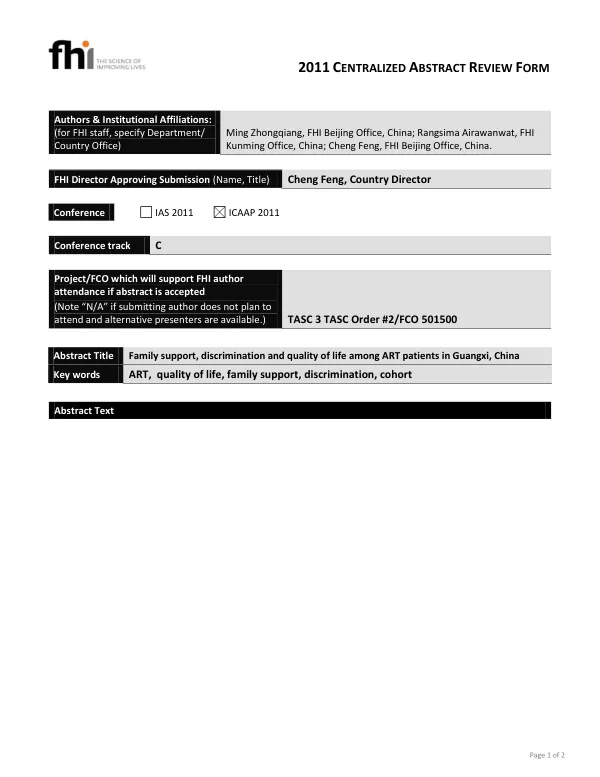
Family support, discrimination and quality of life among ART patients in Guangxi, China
Sign inFAMILY HEALTH INTERNATIONAL
Family support, discrimination and quality of life among ART patients in Guangxi, China
Family support and discrimination have a significant impact on the quality of life among adult ART patients in Guangxi, China.
2011 · 2 pages
Sign in to readA free account is required to download.
Abstract
By December 2007, approximately 5,000 patients were receiving antiretroviral therapy (ART) in Guangxi, China. However, limited studies have been conducted on the effect of family support and discrimination on patients' quality of life (QoL). A cohort study on QoL among adult ART patients in Guangxi was conducted using a survey at baseline, 6, 12, and 24 months. The study was funded by USAID/PEPFAR. Single factor analysis using Generalized Estimating Equations (GEE) assessed relationships between family support, discrimination, and QoL. The results showed that a high proportion of patients received family support throughout the study period, with 90.4% of patients receiving family support at baseline, 91.8% at 6 months, 95.5% at 12 months, and 94.3% at 24 months. The proportion of patients who did not feel discriminated against by their families was also high, with 87.2% of patients not feeling discriminated against at baseline, 90.4% at 6 months, 90.0% at 12 months, and 94.5% at 24 months. The study found that patients' overall QoL scores were positively associated with both having received family support and not feeling discriminated against by their families. The odds ratio for having received family support was 2.6, and the odds ratio for not feeling discriminated against was 3.4, both with a p-value less than 0.01. The study's findings suggest that high levels of family support are present among ART patients in Guangxi, China. Furthermore, increased family support and non-discrimination can enhance patients' quality of life. These results have important implications for the development of interventions aimed at improving the quality of life among ART patients in Guangxi, China.