HEALTH ALLIANCE INTERNATIONAL
Origin and cross-species transmission of bat coronaviruses in China
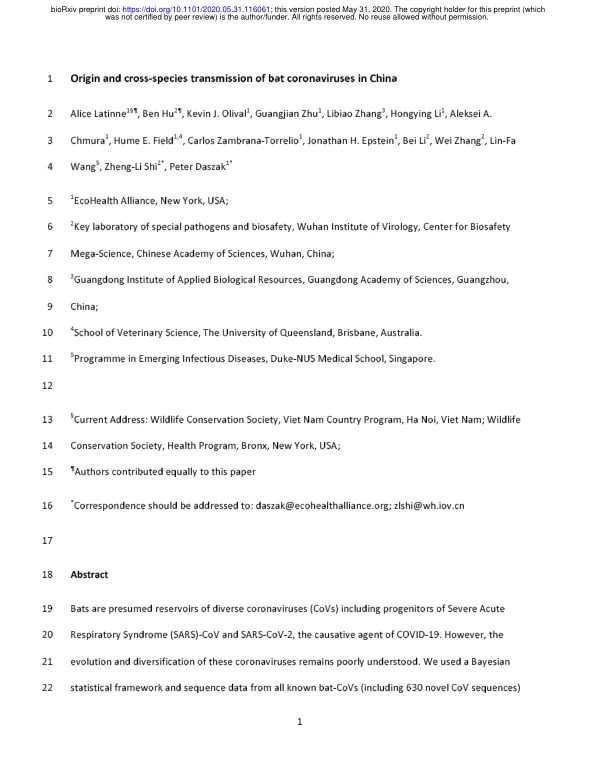
Bats are presumed reservoirs of diverse coronaviruses (CoVs), including progenitors of Severe Acute Respiratory Syndrome (SARS)-CoV and SARS-CoV-2, the causative agent of COVID-19.
2020 · 46 pages
Sign in to readA free account is required to download.
Abstract
However, the evolution and diversification of these coronaviruses remains poorly understood. A study analyzed an extensive field-collected dataset of bat-CoV sequences from across China to compare the macroevolutionary patterns of alpha- and beta-CoVs and identify the hosts and geographical regions that act as centers of evolutionary diversification for bat-CoVs in China. The study used a phylogeographic Bayesian statistical framework to reconstruct virus transmission history between different bat host species and virus spatial spread over evolutionary time. The researchers generated 630 partial sequences of the RNA-dependent RNA polymerase (RdRp) gene from bat rectal swabs collected in China and added 608 bat-CoV and eight pangolin CoV sequences from China available in GenBank or GISAID to their datasets. For each CoV genus, two datasets were created: one including all bat-CoV sequences with known host (host dataset) and one including all bat-CoV sequences with known sampling location at the province level (geographic dataset). The study identified the host taxa and geographic regions that define hotspots of CoV evolutionary diversity in China. The results showed that host-switching was more frequent and across more distantly related host taxa in alpha- than beta-CoVs, and more highly constrained by phylogenetic distance for beta-CoVs. The study also found that inter-family and -genus switching is most common in Rhinolophidae and the genus Rhinolophus. The researchers used a Bayesian discrete phylogeographic approach implemented in BEAST to reconstruct the ancestral hosts and cross-species transmission of bat-CoVs. The results suggested that the host-switching of viruses over evolutionary time is an important mechanism driving the evolution of bat coronaviruses in nature and appears to vary geographically. The study identified the hosts and geographical regions that act as centers of evolutionary diversification for bat-CoVs in China, which could help target bat-CoV discovery for proactive zoonotic disease surveillance. The study's findings have implications for pandemic preparedness and the understanding of how CoVs evolve, diversify, circulate among, and transmit between bat families and genera. The results suggest that bats harbor the largest diversity of CoVs among mammals and that two CoV genera, alpha- and beta-CoVs, have been widely detected in bats from most regions of the world. The study's phylogenetic analysis suggested a likely origin for SARS-CoV-2 in Rhinolophus spp. bats. The study's results highlight the importance of understanding the origin and cross-species transmission of bat coronaviruses in China and the need for continued surveillance and research to identify bat hosts and regions where the risk of CoV spillover is the highest. The study's findings have significant implications for global health and the prevention of future pandemics.