AFRICARE, INC.
FARA Verification Report: Quarter II Year II
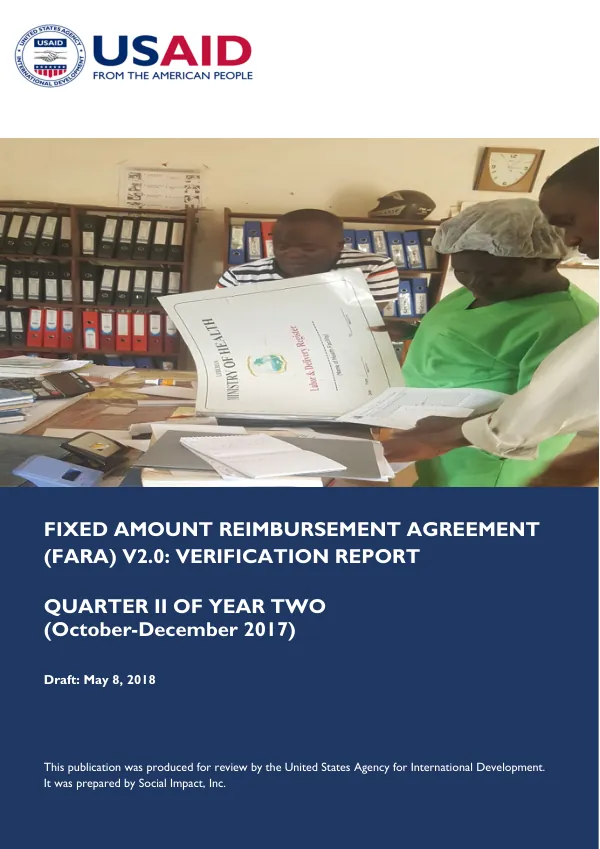
The Fixed Amount Reimbursement Agreement (FARA) v2.0 is a $59.1 million agreement signed between USAID and the Government of Liberia, acting through the Ministry of Health (MoH).
2018 · 27 pages
Sign in to readA free account is required to download.
Abstract
This initiative supports the implementation of Liberia's 2011-2021 National Health and Social Welfare Policy and Plan. FARA v2.0 provides critical support to the Liberia health sector to reduce maternal, neonatal, and child mortality through integrated systems and service delivery investments, while strengthening MoH stewardship and capacity to improve accountability and oversight. FARA v2.0 financially supports the provision of health services in Bong, Lofa, and Nimba counties, targeting 115 health facilities. The Government of Liberia (GoL) pre-finances FARA v2.0 through the national budget, with USAID reimbursing fixed amounts quarterly to the GoL for the achievement of predetermined outputs. The agreement period of performance is January 1, 2016 to December 31, 2020. The purpose of this round of verification was to ensure that the selected deliverables comply with agreed standards and are managed fairly, efficiently, and effectively. The emphasis for this round of verification was placed on hard-to-reach health facilities in the targeted counties because they are often underserved or left out by the supervision team. The verification was meant to collect evidence of the deliverables through desk review, field visits, interviews, and observation for Quarter II of Year II (October – December 2017). The verification exercise covered the three target counties (Bong, Lofa, and Nimba). The data collection method used in this verification involved desk review of reports submitted to USAID, including review of documents and other materials from MoH and USAID FARA Management Team. In addition, meetings were held with the FARA team at MoH to finalize the verification plan. The verification process also used key informant interviews with County Health Teams (CHTs) and Implementing Partners (IPs). In addition to observing work processes at each health facility visited, a group discussion was conducted with a cross-section of available staff members. The verification field exercise lasted for 14 days from March 25th to April 7th. The verification was conducted by a team of four LSA M&E Specialists. During the first week of field work, the DQA Team split into two sub-teams: one team worked in Bong and the second team worked in Lofa. Both teams merged in Nimba to finalize the verification for the last week. The verification report outlines achievements, observations, and recommendations for improvement of the FARA intervention. Several achievements were validated, including the Ministry of Health conducting an internal audit of the CHTs, and commissioned external audits of its implementing partners (Africare and IRC). Participants in the three counties confirmed that thirty-three persons attended the EmONC training, as reported in the iHRIS. The District and County Health Teams conducted Joint Integrated Supportive Supervision (JISS) visits across all the facilities visited by the verification team. However, some deliverables were not achieved, including the service delivery and administrative bonus payments for the quarter under review, which have not been made to the beneficiaries. Based on these findings and observations, the LSA recommends the following: internal and external auditors should hold debrief sessions with the CHTs prior to their departure from the counties and audit reports should be provided to the CHTs for timely informed decision making. The MoH should ensure that draft audit reports are filed with IPs & CHTs while awaiting final versions. CHTs and IPs should retroactively pay all outstanding bonuses and improve on timely payment moving forward.