USAID DEC
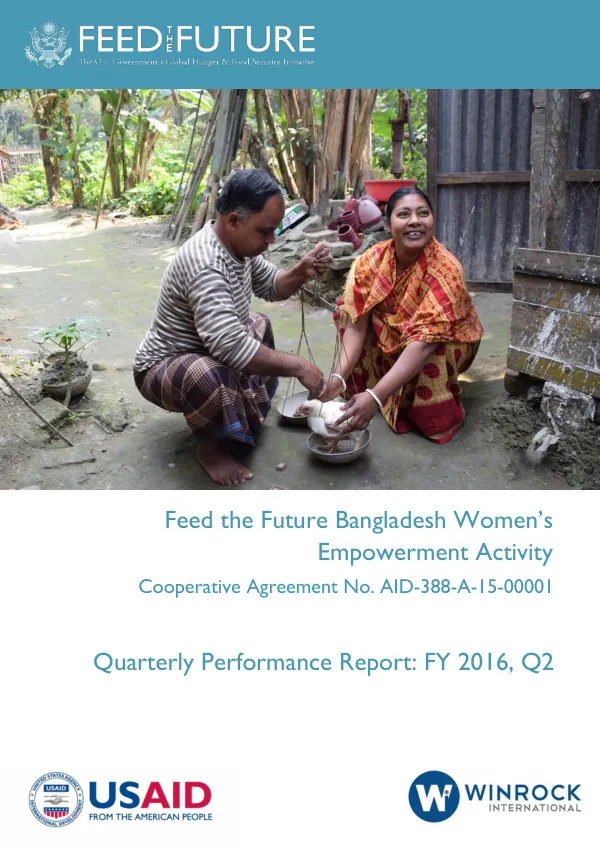
Feed the Future Bangladesh Women’s Empowerment Activity | Quarterly Performance Report: FY 2016, Q2
Sign inWINROCK INTERNATIONAL FOUNDATION
Feed the Future Bangladesh Women’s Empowerment Activity | Quarterly Performance Report: FY 2016, Q2
The Feed the Future Bangladesh Women's Empowerment Activity is a three-year program aimed at increasing the empowerment of women and gender equality in targeted areas of the Feed the Future Zone of Influence.
2016 · 13 pages
Sign in to readA free account is required to download.
Abstract
The program is implemented by Winrock International and its partners, including Dhaka Ahsania Mission, Sheba Manush Kallyan Keng, SAINT Bangladesh, Nabolok, and Advanced Chemical Industries. During the second quarter of FY 2016, the program focused on field-level activities and capacity building of partner organizations. Key activities included district inception workshops in three new districts, 11 union, and 29 upazila-level workshops. A new Gender Specialist and M&E Specialist were approved by USAID and joined the team in March 2016. Local Advisory Committees (LACs) were formed in 78 new areas, with 1,336 (717 female, 619 male) members oriented on their roles and responsibilities. LACs have been actively engaging with the project, leading Community Asset Appraisals, and promoting women's attendance in training sessions. Community Asset Appraisals (CAAs) were facilitated by LACs and partner staff, involving 28,031 (23,738 female, 4,293 male) local villagers. Beneficiary selection resulted in 19,450 (16,925 female, 2,525 male) new beneficiaries. Peer leaders were selected, with 320 female and 172 male volunteers willing to conduct behavior change and awareness activities. The program also collaborated with the USAID-funded Rice Value Chain project, implemented by IRRI, and provided a roster of 47 women's groups for training. Agricultural Technical Training (ATT) was completed by ACI Agribusiness, with 12 two-day trainings covering different agriculture products and production techniques. These trainings aimed to provide women with access to training and employment opportunities. Entrepreneurial Literacy Training for Empowerment (ELTE) selected 316 female and 22 male facilitators, who will conduct training sessions for women's groups. The program also worked on improving women's control over income, with a focus on entrepreneurial skills development. The Rice Value Chain project was implemented, with IRRI conducting training on February 16, 2016, for 25 women beneficiaries. The program aims to increase women's control over income and improve their decision-making power over productive resources. The program's progress is monitored and evaluated through regular reporting and quarterly reports are submitted to USAID. The program's financial summary is presented in the report, showing a total expenditure of $1,000,000. The program's target vs. achievement is also presented, showing a 27% increase in household income among program participants compared to the control group. The program's planned activities for the next quarter include the development of a sustainability plan for ELTE groups, the implementation of savings and credit activities, and the continuation of LAC formation and CAA activities. The program will also work on strengthening the capacity of partner organizations and partner organizations will continue to implement the program's activities. The program's success story is presented in Annex II, highlighting the achievements of a woman who was elected as a Union Parishad member in recent elections. The program's progress is also presented in the report, showing the number of LACs formed, CAAs facilitated, and beneficiaries selected, as well as the number of peer leaders selected and trained.
Related documents