BANGLADESH AGRICULTURAL UNIVERSITY
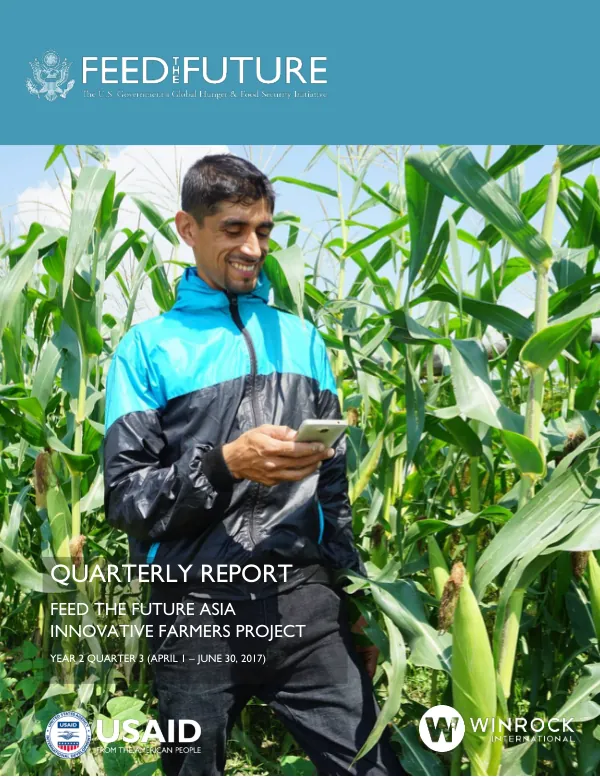
Quarterly Report: Feed the Future Asia Innovative Farmers Activity
The Feed the Future Asia Innovative Farmers Activity (AIFA) is a regional project working to facilitate the scaling of critical agricultural technologies through regional partnership and technology transfer.
2016 · 22 pages
Sign in to readA free account is required to download.
Abstract
The project aims to increase food security, reduce poverty, and improve environmental sustainability by facilitating agricultural innovation and technology diffusion in the Asia region. AIFA is comprised of four components: Horticulture-focused package of interventions, Aquaculture-focused package of interventions, Regional demand-driven packages of interventions to address food security, and Technology transfer to support USAID bilateral mission-oriented interventions. The project has made significant progress in developing local private sector partnerships and identifying key smallholder issues that project-supported testing must address. A major milestone was achieved when Kasetsart University signed its sub-agreement with the project, enabling the project to arrange a Training of Trainers (TOT) at Kasetsart on August 9-13 to prepare all partners for implementation. The project also completed a joint planning and participant selection trip to Jessore district in Bangladesh with the Feed the Future Women's Empowerment in Agriculture project (WEA) to conduct Technology, Market, and Model testing with a focus on gender issue learning. The project has developed a simple technology transfer chain graphic to represent how the roles can be understood in terms of the stages of technology transfer and scaling. The graphic locates the project's activities in the first two stages of transfer, namely identification of innovations (which will be accomplished through the Tech4 Farmers Challenge) and decision support for expansion into new markets (which will be accomplished through Technology, Market, and Model testing in the target markets). These activities represent the project's approach to direct technology transfer facilitation. The project is also supporting the strengthening of the regional agricultural innovation system through an integrated approach that includes a Regional Innovation Hub at Kasetsart University, a series of regional and national level innovation events, and a competitive, grants-based local community development scheme that will encourage grass-roots organization. The project has received 14 technology challenge applications and more than 1,400 views on the temporary landing page for the Tech4Farmers challenge. The project has also achieved excellent initial cooperation with bi-lateral Feed the Future projects on fast-track technologies, including agreement to co-finance testing with the Agricultural Value Chains project (AVC) and the Women's Empowerment in Agriculture project (WEA) in Bangladesh on pest exclusion nets, and the Aquaculture for Income and Nutrition project (AIN) on sensor-enabled aquaculture in Bangladesh. The project has also contacted the INGENAES project to field test a tool specifically designed to assess technologies' impacts on women. In Bangladesh, the project conducted a market introduction tour with e-Fishery CEO and 25 Bangladesh aquaculture stakeholders, resulting in e-Fishery board approval for Bangladesh expansion testing and multiple local companies requesting distribution rights. The project has also identified critical gender issues that will be explored through testing, including the ban on women purchasing pesticides and agro-chemicals in Bangladesh.