CNFA, INC.
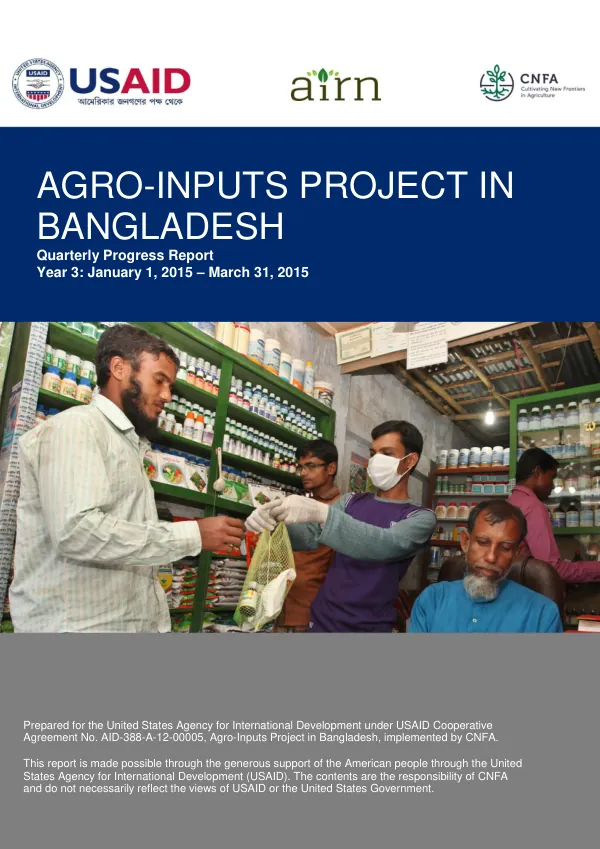
USAID Agro-Inputs Project in Bangladesh: Quarterly Progress Report Y3Q2
The Agro-Inputs Project in Bangladesh aims to improve the knowledge and supply of quality agricultural inputs through a network of credible input retailers.
2015 · 42 pages
Sign in to readA free account is required to download.
Abstract
The project's objective is to create a sustainable Agro-Input Retailers Network (AIRN) that will supply quality agricultural inputs to over one million farmers in 20 Feed the Future (FTF) districts. The project's four interventions are: establishment of an Agro-Input Retailers Network, development of Market Information Systems, setting Quality Control Standards for Inputs and Lessening Regulatory Constraints, and strengthening Local Organizations. The creation of AIRN is designed to build the technical and business capacity of 3,000 licensed retailers in 20 FTF districts. Among the 3,000 agri-retail shops, 300 will be women-owned businesses. All retailers will be supported to make informed business decisions for efficient, ethical, and technically-sound operations. The project distributes an Ag-Inputs Monthly Price Outlook Bulletin (MPOB) for seeds, fertilizers, and plant protection products, which is underpinned by geographic information system (GIS) to depict a visual representation of input distribution networks, transportation infrastructure, client concentration, cropping patterns, product and price trends, and other important business information. Improving quality control standards and lessening regulatory constraints involves working with industry associations and the Government of Bangladesh (GoB) to improve industry standards for major crops. In addition, the project is working with these input associations to identify constraints in the implementation of existing regulations, particularly in seed, and assert their collective voice. The project is also strengthening local organizations through capacity building to organizations such as industry associations, local NGOs, and AIRN. During the second quarter of Year 3, 339 new members joined AIRN from 59 upazillas in 16 districts, bringing the total number of members to 1,842. Of this total, 830 AIRN members have attained accredited status, while the remaining will be awarded accredited status after completing the required basic trainings. The Advisory Board of AIRN met in March 2015 to discuss and elicit feedback on the existing AIRN objectives, membership, registration status, and goal of becoming a registered training organization. The Board is also working on a draft AIRN business plan to be completed in Year 3, Quarter 3. The project aims to award 300 matching grants over the life of the project to promote and support female-owned and operated agro-inputs' retailerships. During this quarter, the first tranche of 16 grant applications was approved by USAID, while tranches 2 and 3 (total of 26 applications) were approved by the AIP Technical Evaluation Committee (TEC) and await USAID approval. The project held one batch of retailer training on "appropriate use and sales of agricultural inputs" for 26 AIRN member retailers and an environmental compliance training in Jessore for 18 participants, including AIP/AIRN field officers and USAID/Agricultural Extension Support Activity (AESA) staff. The project is currently planning a second international study tour to Thailand to be carried out in the next quarter. The study tour aims to provide AIRN members with an opportunity to learn from international best practices in agro-inputs retailing and to share their own experiences with international counterparts. The project's progress in the second quarter of Year 3 has been significant, with the establishment of new AIRN members, the approval of grant applications, and the planning of a second international study tour.