USAID DEC
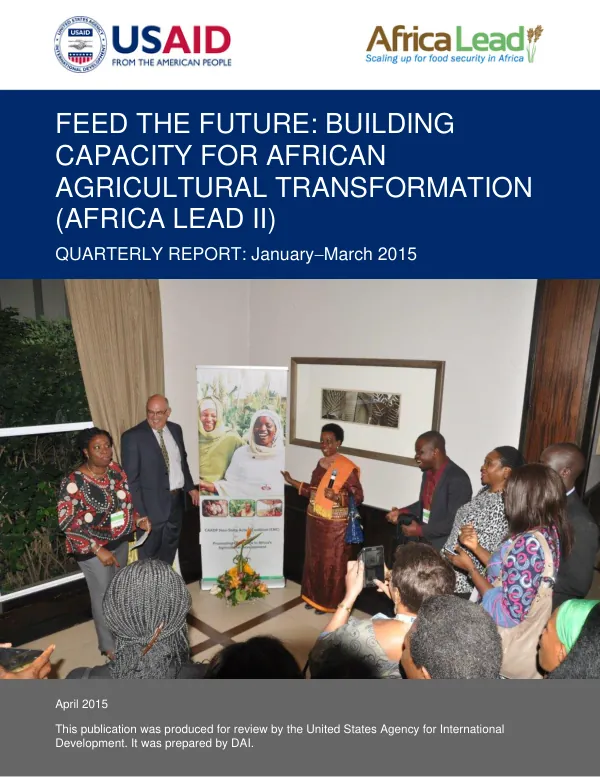
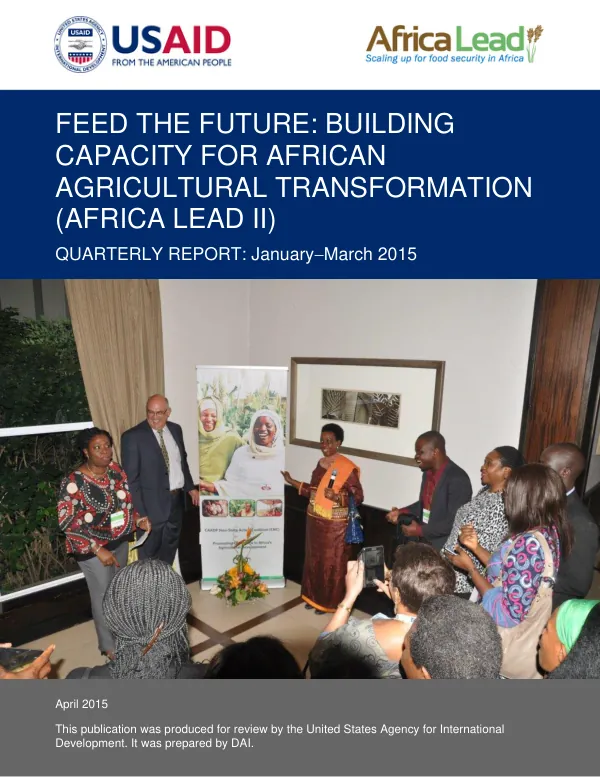
Feed the Future: Building Capacity for African Agricultural Transformation (Africa Lead II) Quarterly Report: January–March 2015
Sign inDAI
Feed the Future: Building Capacity for African Agricultural Transformation (Africa Lead II) Quarterly Report: January–March 2015
Africa Lead II is a five-year Cooperative Agreement between USAID and a DAI-led Consortium, which includes Training Resources Group, Management Systems International, and Winrock International.
2015 · 44 pages
Sign in to readA free account is required to download.
Abstract
The program aims to support and advance agricultural transformation in Africa as proposed by the African Union Comprehensive Africa Agriculture Development Program (CAADP). The program's purpose is to strengthen the capacity of African institutions to manage agricultural development, promote inclusive participation of non-state actors in the policy process, and support the effective implementation of the CAADP policy change and alignment process. The program is structured into three components. Component One focuses on improving institutional capacity to manage agricultural development, which includes identifying key food security institutions, providing assistance to strengthen their performance, and supporting customized leadership and management training. Component Two aims to strengthen capacity to manage and implement the policy change and alignment process, which involves designing and delivering agriculture policy training workshops, strengthening institutional architecture for improved policy and evidence-based policy reform, and facilitating the adoption of mutual accountability frameworks and joint sector review processes. Component Three promotes the effective and inclusive participation of non-state actors in the policy process, which includes identifying and selecting non-state actor counterparts to engage in the CAADP policy process, building capacity of key non-state actor groups to support CAADP objectives, and facilitating non-state actor support to CAADP objectives. The program also includes knowledge management, learning, and communications, as well as monitoring and evaluation tasks. During the January to March 2015 quarter, Africa Lead II achieved several accomplishments. In Component One, the program identified key food security institutions and provided assistance to strengthen their performance. In Component Two, the program designed and delivered agriculture policy training workshops and strengthened institutional architecture for improved policy and evidence-based policy reform. In Component Three, the program identified and selected non-state actor counterparts to engage in the CAADP policy process and built capacity of key non-state actor groups to support CAADP objectives. The program also made progress in knowledge management, learning, and communications, as well as monitoring and evaluation. The program established baselines and performance targets, conducted data collection and analysis, and participated in a complexity-aware monitoring pilot. The program's results framework and indicators performance tracking table (IPTT) are also included in the quarterly report. Overall, Africa Lead II is making progress in supporting and advancing agricultural transformation in Africa, as proposed by the African Union Comprehensive Africa Agriculture Development Program (CAADP). The program's accomplishments and progress in the January to March 2015 quarter demonstrate its commitment to strengthening the capacity of African institutions to manage agricultural development, promoting inclusive participation of non-state actors in the policy process, and supporting the effective implementation of the CAADP policy change and alignment process. The program's geographic focus is on Africa, with a specific emphasis on the regions of East Africa, West Africa, and Southern Africa. The program's timeframes are from 2013 to 2018, with a quarterly reporting cycle. The program's recommendations for future action include continuing to support and advance agricultural transformation in Africa, strengthening the capacity of African institutions to manage agricultural development, and promoting inclusive participation of non-state actors in the policy process.