FINTRAC
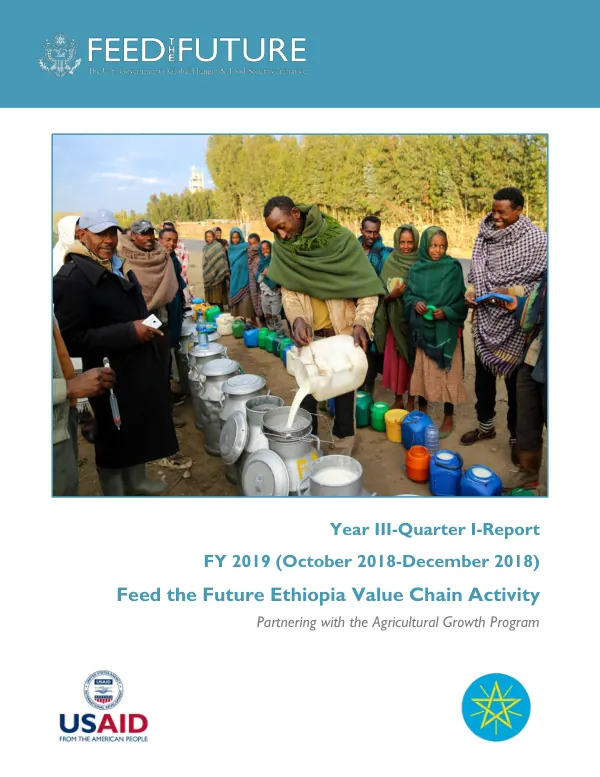
Quarterly Report Q1 FY 2018: Feed the Future Ethiopia Value Chain Activity
The Feed the Future Ethiopia Value Chain Activity is a five-year initiative funded by the US government's Feed the Future Initiative and the Government of Ethiopia's Agricultural Growth Program (AGP) II, Component Four: Agriculture Marketing and Value Chains.
2018 · 22 pages
Sign in to readA free account is required to download.
Abstract
The activity aims to improve agricultural productivity and commercialization of smallholder farmers through an inclusive value chain and market systems development strategy. The program expects to reach at least 1.5 million rural farmers with improved technologies and prioritizes work across select AGP II value chains, including maize, coffee, chickpea, dairy, livestock, and poultry. The activity focuses on 43 strategic woredas within AGP II regions, with the goal of increasing the potential of selected value chains to produce more, reduce poverty, withstand shocks, and improve incomes and nutrition. The program targets five key value chains, including maize, coffee, chickpea, dairy, and meat and live animals, with the inclusion of poultry as a sixth value chain from 2018 onwards. The activity also supports connections between the chains, such as fodder production and input supply. In the first quarter of Fiscal Year 2018, the activity concentrated on completing the final phase of staff recruitment, continuation of stakeholder meetings, capacity building, and the commencement of on-the-ground technical trainings and demonstrations of Good Agricultural Practices (GAPs). By the end of this quarter, FTFE VCA's team consisted of 72 full-time personnel dispersed through FTFE VCA's Addis Ababa office, three regional offices, and two satellite offices. The program continued to hold stakeholder meetings, with agendas shifting to work planning and scheduling of events and partnerships. Extensive capacity building continued through trainings and events with the Government of Ethiopia, other development organizations, and private sector companies. These trainings and events centered on different agricultural policies, alliances, facilitation of Business to Business (B2B), and discussion and promotion of financial support services. This quarter was particularly exciting for the activity as it began on-the-ground technical work with beneficiaries through trainings and demonstrations. Summary of key achievements in the first quarter of FY 2018 include trainings on GAPs of activity value chains, establishing demonstration plots to promote GAPs, evaluation and promotion of different technologies, concentration on Fall Armyworm Management strategies, and work planning for 2018. Capacity building activities included leadership trainings, strategic meetings on agricultural commercialization, and promotion of public-private dialogue. The program also completed FTFE VCA contract deliverables, including the Baseline Report, FTFE VCA value chain analyses for maize, chickpea, coffee, dairy, meat, and live animal sectors, Gender Action Plan, and Grants Under Contract (GUC) Manual. The Feed the Future Ethiopia Value Chain Activity is working to strengthen commercial relationships between smallholder farmers and agribusinesses, build consensus and action around key constraints to enhance value chain efficiency and induce growth, and mainstream gender and youth to ensure transformative change. The strategy is underpinned by high-quality technical assistance, strategic use of subawards tied to field demonstrations and trainings, and a rigorous program of field-based support and monitoring, evaluation, and learning.