FEED THE FUTURE
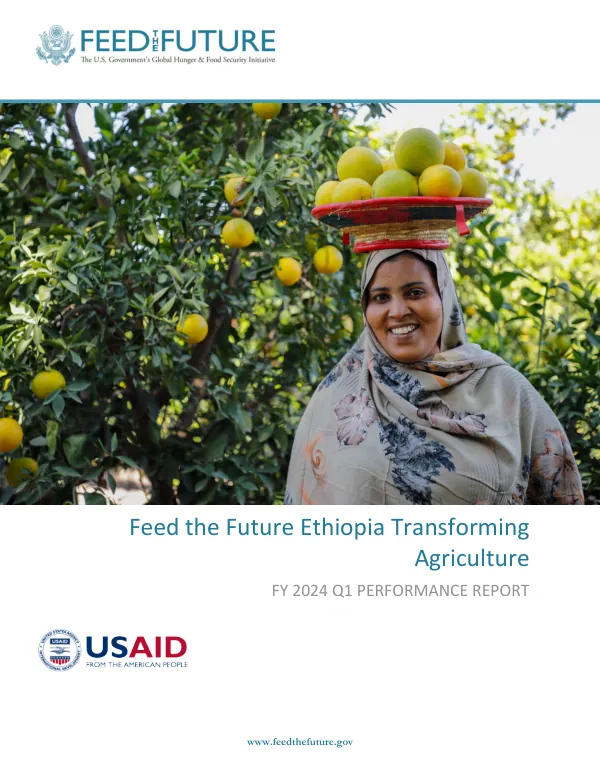
Feed the Future Ethiopia Transforming Agriculture FY2024 Q1 Performance Report
Feed the Future Ethiopia Transforming Agriculture FY 2024 Q1 Performance Report highlights progress toward intermediate results, with a focus on increased availability of safe, diverse, and nutritious foods, increased incomes in the food and agriculture sectors, and increased convenience and desirability of safe, diverse, and nutritious foods.
2024 · 38 pages
Sign in to readA free account is required to download.
Abstract
Progress Toward Intermediate Results IR1: Increased Availability of Safe, Diverse, and Nutritious Foods is being addressed through various initiatives. Horticulture is a key area of focus, with contract farming of avocados and oranges showing promising results. Connecting farmers to processors has also been a priority, with over 1,000 farmers participating in the program. Improved wheat seed multiplication and commercialization has also seen significant progress, with a 25% increase in seed production. IR2: Increased Incomes in the Food and Agriculture Sectors is being achieved through various initiatives, including the National Market Information Systems, the Somali Region MSME Initiative, and the Food Market and B2B Event. These initiatives have resulted in increased market access and improved prices for farmers, leading to higher incomes. Collaboration with the Ministry of Industry and Integrated Agro-Industry Parks has also been a key area of focus, with the establishment of several new parks and the development of new business models. IR3: Increased Convenience and Desirability of Safe, Diverse, and Nutritious Foods is being addressed through various initiatives, including the provision of technical support to upgrade Good Manufacturing Practices and Quality Assurance Systems with selected food manufacturers. This has resulted in improved food safety and quality, making nutritious commodities more desirable to consumers. Behavioral changes on the utilization of nutritious commodities have also been promoted, with a focus on increasing the demand for nutritious foods. Implementation details for projects and programs include the provision of training and capacity building for farmers, processors, and other stakeholders. This has resulted in improved skills and knowledge, leading to increased productivity and efficiency. Market linkage facilitation has also been a key area of focus, with the establishment of new markets and the development of new business models. Geographic focus and context include the Amhara and Oromia regions, where the majority of the program's activities are taking place. The program is also working with the Government of Ethiopia to address the root causes of poverty and hunger, including limited access to markets and poor agricultural practices. Timeframes and recommendations include the completion of the baseline survey and the establishment of a Collaborating, Learning, and Adapting (CLA) system. The program is also working to strengthen partnerships with development-funded projects and to improve the policy environment for fertilizer and land. Challenges encountered include inflation, foreign exchange, and external trade, which have had a negative impact on the program's activities. Lessons learned include the importance of working closely with local stakeholders and the need for flexible programming to respond to changing circumstances. Priorities for the next quarter include the completion of the CLA system and the establishment of a new market information system. The program will also continue to work with the Government of Ethiopia to address the root causes of poverty and hunger. Annex 1: Success stories highlights the achievements of the program, including the increased availability of safe, diverse, and nutritious foods, increased incomes in the food and agriculture sectors, and increased convenience and desirability of safe, diverse, and nutritious foods.