USAID DEC
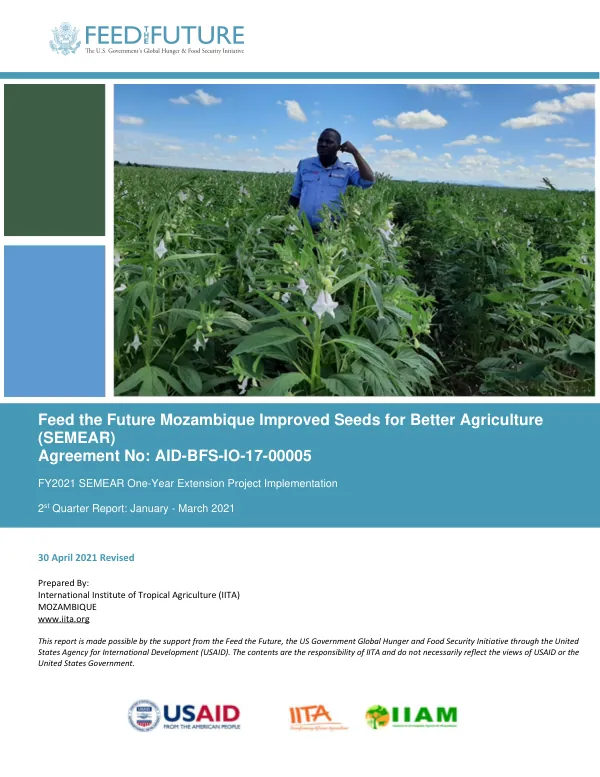
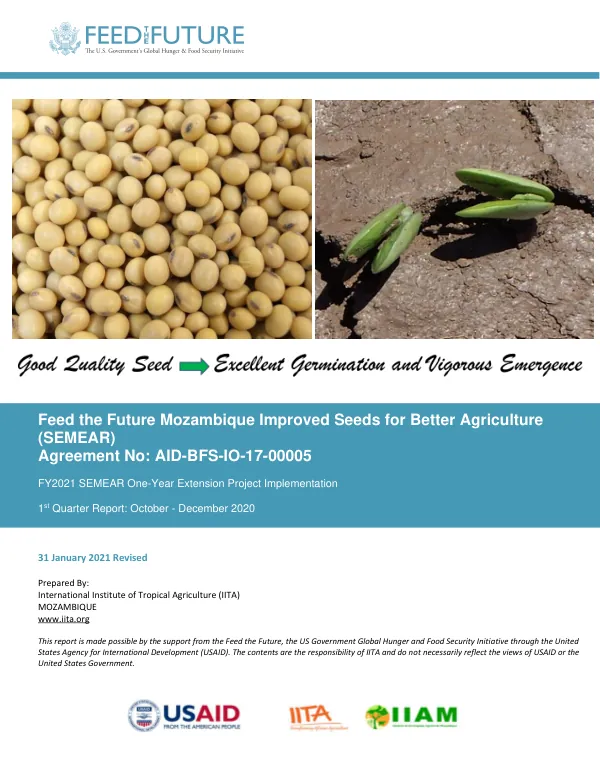
FY2021 SEMEAR One-Year Extension Project Implementation 1st Quarter Report: October 2020 – December 2020
Sign inFEED THE FUTURE
FY2021 SEMEAR One-Year Extension Project Implementation 1st Quarter Report: October 2020 – December 2020
The Feed the Future Mozambique Improved Seeds for Better Agriculture (SEMEAR) project is a six-year initiative aimed at improving agricultural productivity and food security in Mozambique.
2021 · 32 pages
Sign in to readA free account is required to download.
Abstract
The project, which began in October 2015 and is set to conclude in September 2021, has a total budget of US$13,346,185. The geographic focus of the project is on four provinces in Mozambique: Nampula, Zambézia, Manica, and Tete. The project's objectives are threefold: to build on the production and supply of breeder, pre-basic, basic, certified seed, and quality declared seed (QDS) of common bean, cowpea, groundnut, pigeon pea, sesame, and soybean in the Feed the Future Zone of Influence (FTF ZOI); to strengthen the national seed systems in planning, coordination, and production of early generation seed (EGS) through capacity development; and to scale-up and enhance the adoption of good quality seeds of improved varieties and best management practices in the FTF ZOI. During the first quarter of FY2021 (October-December 2020), the project made significant progress in achieving its objectives. The project supported partners, including seed companies, individual seed producers, farmers' associations, and NGOs, to produce certified and quality declared seed (QDS) through the sale of basic seeds, training, and technical support on seed production. A total of 21.2 tons of basic seed were sold to seed companies, agro-dealers, farmers associations, and community-based seed producers to produce certified seed, which is expected to plant 1,054 ha of certified seed fields. The project also organized a meeting with IIAM grain legume breeders to plan and coordinate breeder seed production. Seed road map and foresight analysis on the quantities of EGS were conducted to ensure the availability of high-quality seeds for the upcoming planting season. The project planted 8.8 ha of breeder/pre-basic and 58.25 ha of basic seed fields of common bean, groundnut, pigeon pea, and soybean. Cowpea and sesame are late-planted crops and will be planted in the second quarter around mid-January 2021. The project's capacity development activities focused on training seed producers and farmers on good crop management practices and the production of EGS. The project also conducted awareness creation activities to promote the benefits of improved varieties and best management practices among farmers and other stakeholders. The project's efforts led to the increased production and supply of good quality seeds that were distributed to farmers and other stakeholders in the FTF ZOI and across the country. The project's performance indicators, including the production and distribution of EGS, the adoption of good quality seeds, and the improvement of agricultural productivity, will be closely monitored to ensure the project's success. The project's collaboration with other donor projects and its contribution to the development of resilient farming systems that play a major role in feeding the country and contributing to economic growth are also key aspects of the project's implementation.
Related documents