USAID DEC
Feed the Future FY 2011–2015 Multi-Year Strategy for Tajikistan
The Feed the Future (FTF) Multi-Year Strategy for Tajikistan outlines a five-year strategic plan for the U.S.
2012 · 53 pages
Sign in to readA free account is required to download.
Abstract
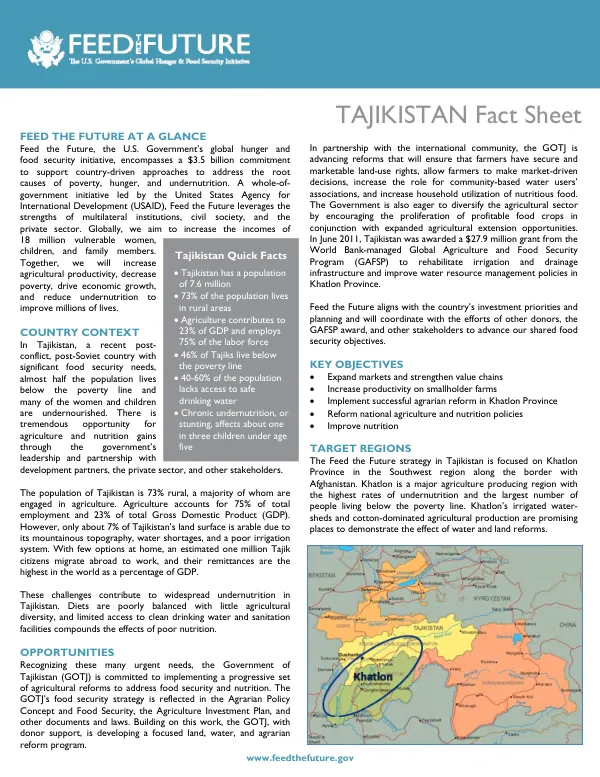
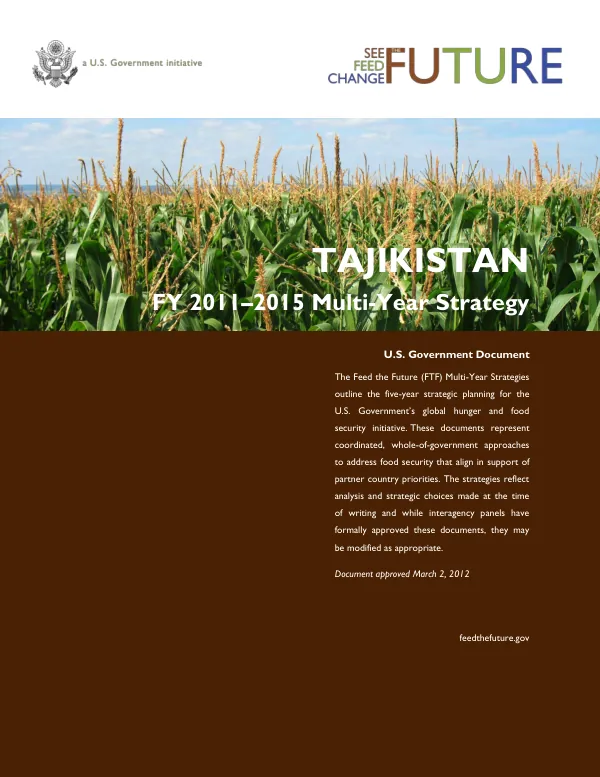
Government's global hunger and food security initiative. This document represents a coordinated, whole-of-government approach to address food security in Tajikistan, aligning with partner country priorities. The strategy reflects analysis and strategic choices made at the time of writing and may be modified as necessary. The context of Tajikistan is characterized by a complex history and politics, with a population of approximately 7.5 million people. The country has a diverse geography, with mountains, valleys, and deserts, which affects agricultural production and access to markets. The agricultural sector is a significant contributor to the country's economy, with cotton being a major crop. However, the sector faces challenges such as soil degradation, limited market access, and a lack of irrigation infrastructure. The strategy identifies several key assumptions, including the inevitability of food imports, the need for crop diversification in traditional cotton-growing areas, and the importance of concentrating efforts in Khatlon Province. The strategy also emphasizes the need to leverage current U.S. Government programs and donor collaboration to achieve its objectives. The strategy is organized into three pillars: Assistance to Household and Small Commercial Farms, Building the Capacity of Local Institutions and Community-Based Organizations, and Completion of Effective Agrarian Reform in Selected Districts of Khatlon Province. Pillar I aims to increase incomes, improve and increase production for household consumption, and improve nutrition and health. Pillar II focuses on building the capacity of local institutions and community-based organizations, including agricultural extension, gender roles, and community-based civil society organizations. Pillar III aims to complete effective agrarian reform in selected districts of Khatlon Province, including ongoing agrarian reform and national policy reform. The strategy also identifies several risks, including regional trade interrupted, civil disorder spilling over from Afghanistan or elsewhere, corruption, villages or jamoats refusing to cooperate, value chain development difficulties, and poor donor coordination. To mitigate these risks, the strategy outlines several intermediate results, including markets expanded and value chains strengthened, small farm productivity increased, and successful agrarian reform demonstrated in Khatlon Province. The strategy emphasizes the importance of working with local institutions and community-based organizations to achieve its objectives. It also highlights the need for a market-oriented regulatory regime for agriculture and the importance of addressing cross-cutting issues such as regional trade, Afghanistan, climate change, and local government. Overall, the FTF Multi-Year Strategy for Tajikistan aims to improve food security and reduce poverty in the country by supporting the development of the agricultural sector and improving access to markets.
Related documents