USAID DEC
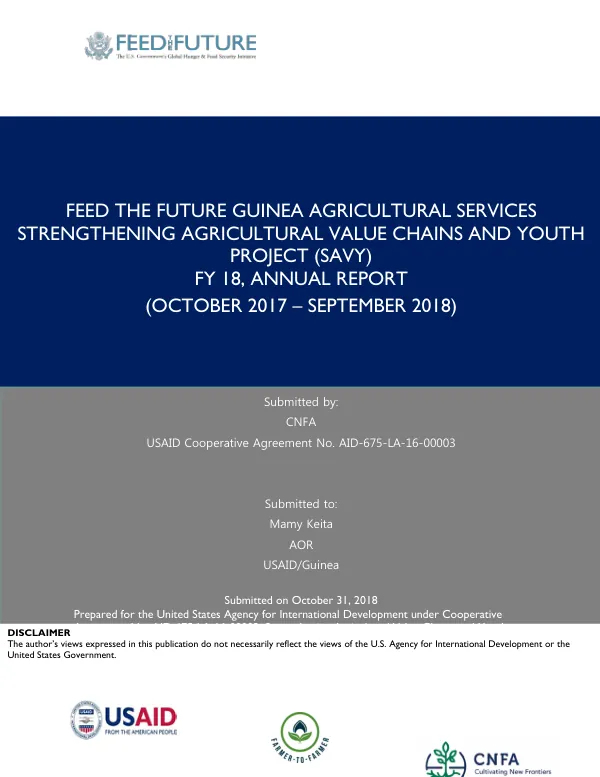
FEED THE FUTURE GUINEA AGRICULTURAL SERVICES STRENGTHENING AGRICULTURAL VALUE CHAINS AND YOUTH PROJECT (SAVY) FY 18, ANNUAL REPORT (OCTOBER 2017 – SEPTEMBER 2018)
Sign inACDI/VOCA
FEED THE FUTURE GUINEA AGRICULTURAL SERVICES STRENGTHENING AGRICULTURAL VALUE CHAINS AND YOUTH PROJECT (SAVY) FY 18, ANNUAL REPORT (OCTOBER 2017 – SEPTEMBER 2018)
The agricultural development initiative in Guinea began in 2015 with funding from USAID's Feed the Future Program.
2018 · 56 pages
Sign in to readA free account is required to download.
Abstract
The goal of the initiative is to improve the availability, quality, and range of agricultural inputs and credits to support production, marketing, storage, and processing for value chain development. The program focuses on the rice, horticulture, and livestock value chains. The SAVY program, which is a 5-year initiative, began on October 5, 2016, and is expected to end on October 5, 2021. The program involves partnerships among six international NGOs, including ACDI/VOCA, CNFA, DAI, JSI, OIC, and Winrock International. The overall goal of the GAS program is to improve the utilization of Guinea's natural resources for a sustainable small-farm sector that is more productive and profitable. The SAVY program has two main objectives: to increase the availability, quality, and range of agricultural inputs and credits, and to increase market information and flow along value chains. The program aims to facilitate higher-quality produce, expand market opportunities, and reduce post-harvest losses. In the second year of implementation, the USAID Guinea and Sierra Leone Mission asked CNFA to review SAVY's activities and link project value work with GHSA activities for higher impact. CNFA reviewed SAVY's activities and identified three main intervention areas: IR1. Animal health promotion and animal disease outbreak mitigation; IR2. Financial Inclusion; and IR3. Market Facilitation. These intervention areas have a major cross-cutting activity, the AVENIR program. The AVENIR program aims to promote animal health and zoonotic disease outbreak response through local networks of veterinarians and trained volunteers. The program focuses on interventions that contribute to animal health promotion and animal disease outbreak mitigation. The SAVY work plan for FY 2018 included a general strategy for the above-mentioned intervention areas. The SAVY program has made significant progress in the second year of implementation. The program has implemented various activities, including animal health promotion and animal disease outbreak mitigation, financial inclusion, and market facilitation. The program has also established partnerships with local organizations and communities to promote sustainable agriculture practices. The SAVY program has achieved several results, including the establishment of a network of veterinarians and trained volunteers to promote animal health and zoonotic disease outbreak response. The program has also facilitated access to financial services for small farmers and promoted market opportunities for agricultural products. The program has also implemented various activities to promote sustainable agriculture practices and reduce post-harvest losses. The SAVY program has also made significant progress in the implementation of its work plan. The program has established a system for real-time data collection and transmission, which has enabled the program to monitor and evaluate its activities effectively. The program has also implemented various activities to promote market facilitation, including the launch of a refrigerated transport truck and the implementation of commercial contracts. The SAVY program has also made significant progress in the implementation of its cross-cutting activities. The program has established partnerships with local organizations and communities to promote sustainable agriculture practices. The program has also implemented various activities to promote animal health and zoonotic disease outbreak response. The SAVY program has also made significant progress in the implementation of its monitoring, evaluation, and learning (MEL) and environmental activities. The program has established a system for monitoring and evaluating its activities, which has enabled the program to track its progress and identify areas for improvement. The program has also implemented various activities to promote environmental sustainability and reduce the program's environmental impact. The SAVY program has also made significant progress in the implementation of its communications and outreach activities. The program has established partnerships with local media outlets and has implemented various activities to promote the program's activities and results. The program has also established a system for communicating with stakeholders and has implemented various activities to promote stakeholder engagement. The SAVY program has also made significant progress in the implementation of its financial management and administrative activities. The program has established a system for managing its finances and has implemented various activities to promote financial transparency and accountability. The program has also established partnerships with local financial institutions and has implemented various activities to promote access to financial services for small farmers. The SAVY program has also made significant progress in the implementation of its results and impact activities. The program has established a system for tracking its results and has implemented various activities to promote the program's impact. The program has also established partnerships with local organizations and communities to promote sustainable agriculture practices. The SAVY program has also made significant progress in the implementation of its AVENIR program. The program has established a network of veterinarians and trained volunteers to promote animal health and zoonotic disease outbreak response. The program has also implemented various activities to promote animal health and zoonotic disease outbreak response. The SAVY program has also made significant progress in the implementation of its GRAND program. The program has established partnerships with local organizations and communities to promote sustainable agriculture practices.