USAID DEC
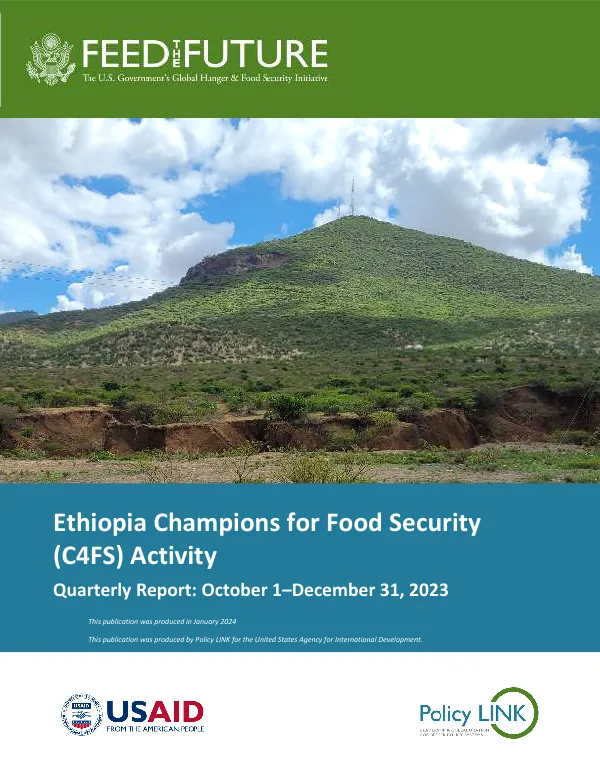
Ethiopia Champions for Food Security (C4FS) Activity Quarterly Report: October 1–December 31, 2023
Sign inDAI GLOBAL, LLC
Ethiopia Champions for Food Security (C4FS) Activity Quarterly Report: October 1–December 31, 2023
The Feed the Future Champions for Food Security activity (C4FS) is a five-year initiative of USAID/Ethiopia, part of the broader seven-year Policy LINK program.
2024 · 19 pages
Sign in to readA free account is required to download.
Abstract
C4FS aims to strengthen the capacity of local actors and institutions to lead and manage the agricultural transformation process, contributing to improved broad-based food security policy outcomes. The overall objective of C4FS is to support the government of Ethiopia and other policy system actors to navigate from a government-led development paradigm to a multi-stakeholder-driven paradigm. In the third year of implementation, C4FS has proposed an expanded scope that considers various contextual changes. This new scope includes an expansion of C4FS' policy system strengthening efforts to focus on implementation capacity at the regional level. The FY2024 workplan includes the proposed expansion, as well as an entirely new intervention area, "Building partnership for lowlands resilience." This new intervention area was approved by USAID in November 2023, and stakeholder consultations have begun to develop the workplan, which will be integrated into the overall C4FS annual workplan. C4FS has made significant progress in the third quarter of FY2024. A draft policy brief was developed based on the findings of the "Policies that incentivize agribusiness investment in Ethiopia" study. The policy brief will be presented to all stakeholders, including relevant officials from the different government ministries, for validation and buy-in on the next course of action. C4FS, in collaboration with the Ministry of Agriculture (MoA) and Sidama Regional Bureau of Agriculture, organized and facilitated the Second Level Land Certification (SLLC)-linked loan sensitization workshop in Hawassa in December 2023. The workshop aimed to raise awareness and sustain the SLLC-linked loan product with expanded engagement of various key stakeholders in the product chain and processes. Additionally, C4FS, in collaboration with Oromia Regional Bureau of Land, and the USAID Land Governance Activity (LGA), organized and facilitated a sensitization workshop on Oromia Regional Land Administration and Use Proclamation. The objective of the workshop was to raise awareness among key stakeholders about the recently approved Proclamation to facilitate its implementation. A similar workshop was also organized in the Sidama Region during this reporting period. Leadership for Change (L4C) training was provided to 38 participants in the Sidama Region. C4FS initiated institutional capacity development activities as one of the focus areas in FY2024 work plan activities, identifying an initial list of institutions for targeted capacity development. Researchable themes were identified and a call for proposals was initiated to facilitate policy research and analysis activities. C4FS, working in collaboration with the Network for Ethiopia Policy Analysis and Research on Agriculture and Food Systems (NET-PARAF) Steering Committee, has finalized the prioritization of key research topics (thematic areas) and development of a term of reference (TOR). The Steering Committee has approved the TOR to seek research proposals for the prioritized research thematic areas. C4FS has finalized the start-up activities of the Partnership for Lowland Resilience, following USAID's approval for the activity. C4FS formed an activity team and initiated stakeholder consultations to develop a workplan, facilitating the first high-level experts' consultation meeting on November 30, 2023, in Addis Ababa. The security situation in Ethiopia has continued to be a stumbling block, limiting field travel and movement within the regions. While the conflict situation in Tigray Region has been improving, the security in other parts of the country, particularly in the Oromia and Amhara regions, remains a challenge. Despite these challenges, C4FS has made significant progress in the third quarter of FY2024, and the activity continues to work towards its objectives of strengthening the capacity of local actors and institutions to lead and manage the agricultural transformation process.
Related documents