USAID/FFP
Humanitarian Assistance in Review East Asia and the Pacific | FY 2003 – 2012
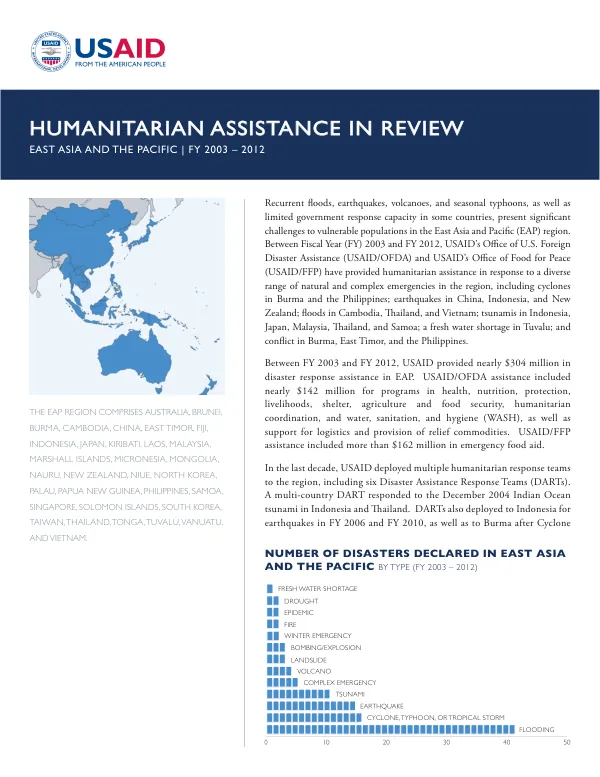
The East Asia and Pacific (EAP) region is characterized by recurrent natural disasters, including floods, earthquakes, and typhoons, which pose significant challenges to vulnerable populations.
2012 · 2 pages
Sign in to readA free account is required to download.
Abstract
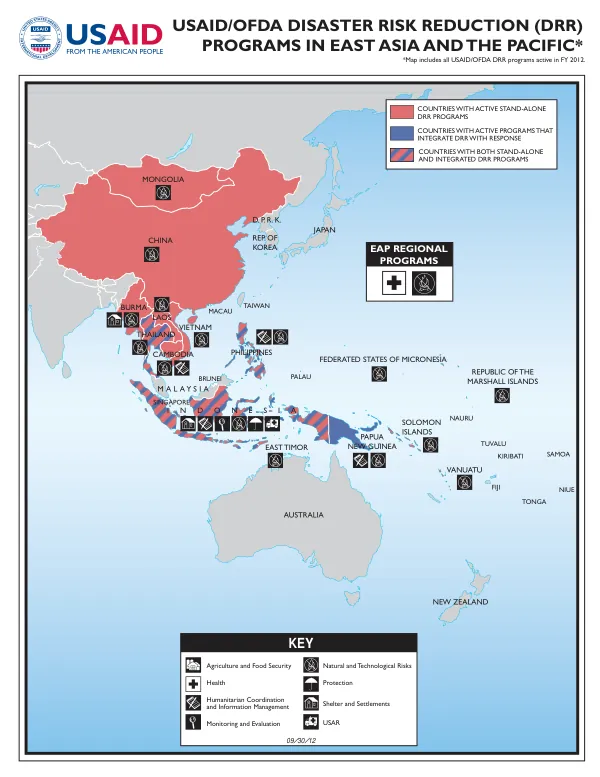
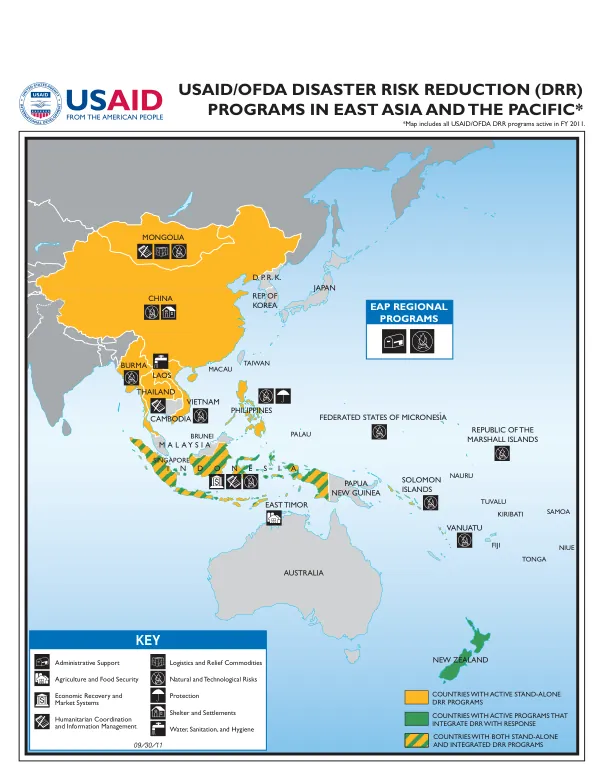
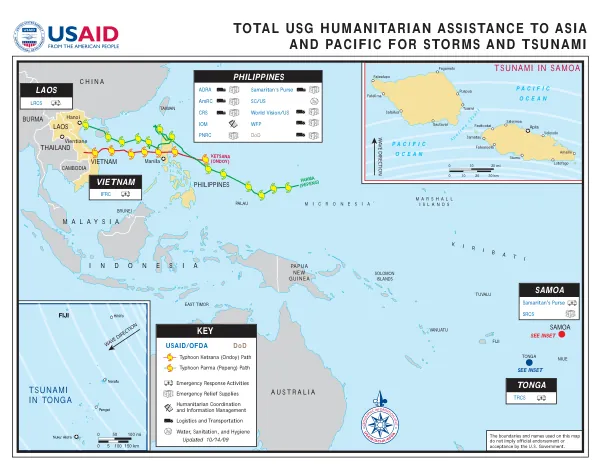
Between Fiscal Year (FY) 2003 and FY 2012, USAID's Office of U.S. Foreign Disaster Assistance (USAID/OFDA) and USAID's Office of Food for Peace (USAID/FFP) provided humanitarian assistance in response to a diverse range of natural and complex emergencies in the region. The EAP region encompasses 37 countries, including Australia, Brunei, Burma, Cambodia, China, East Timor, Fiji, Indonesia, Japan, Kiribati, Laos, Malaysia, Marshall Islands, Micronesia, Mongolia, Nauru, New Zealand, Niue, North Korea, Palau, Papua New Guinea, Philippines, Samoa, Singapore, Solomon Islands, South Korea, Taiwan, Thailand, Tonga, Tuvalu, Vanuatu, and Vietnam. Between FY 2003 and FY 2012, USAID provided nearly $304 million in disaster response assistance in EAP. USAID/OFDA assistance included nearly $142 million for programs in health, nutrition, protection, livelihoods, shelter, agriculture and food security, humanitarian coordination, and water, sanitation, and hygiene (WASH), as well as support for logistics and provision of relief commodities. USAID/FFP assistance included more than $162 million in emergency food aid. In the last decade, USAID deployed multiple humanitarian response teams to the region, including six Disaster Assistance Response Teams (DARTs). A multi-country DART responded to the December 2004 Indian Ocean tsunami in Indonesia and Thailand. DARTs also deployed to Indonesia for earthquakes in FY 2006 and FY 2010, as well as to Burma after Cyclone Nargis in FY 2008. Most recently, in FY 2011, DARTs deployed to New Zealand and Japan in response to earthquakes, a tsunami, and a resulting nuclear emergency. USAID has also activated multiple Washington, D.C.-based Response Management Teams to support DART coordination and response efforts. Due to the recurrent nature of disasters in EAP, USAID/OFDA priorities include supporting and promoting activities to help reduce the vulnerability of populations in disaster-prone areas and increase their resilience to future shocks. USAID/OFDA has developed a regional disaster risk reduction (DRR) strategy to complement emergency assistance interventions and address the underlying causes of vulnerability. The strategy emphasizes building local capacity for disaster mitigation and response and uses activities that are tailored to each country context. Through emergency and development food assistance programs, USAID/FFP works to save lives and reduce food insecurity in times of crisis and situations of chronic food insecurity. USAID/FFP emergency food assistance includes both in-kind food aid and cash-based assistance in the form of local and regional procurement of food commodities, cash transfers, and food vouchers, where market conditions allow.