USAID DEC
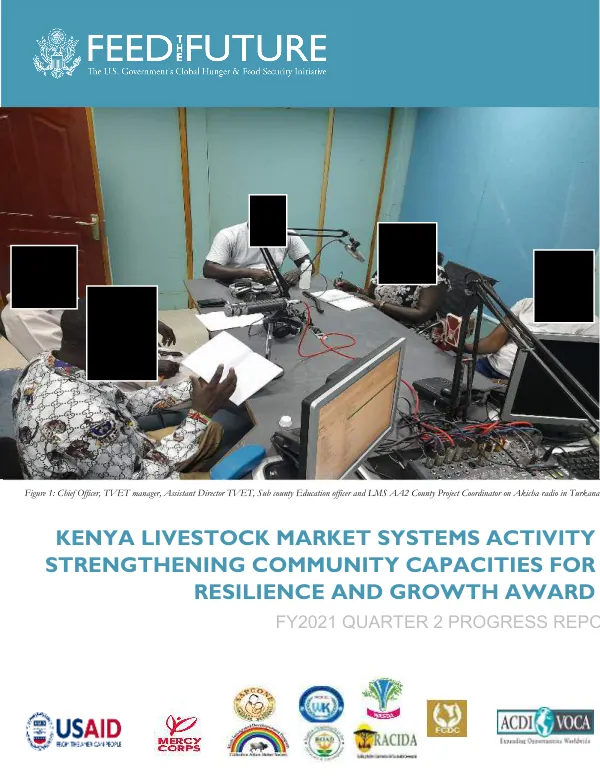
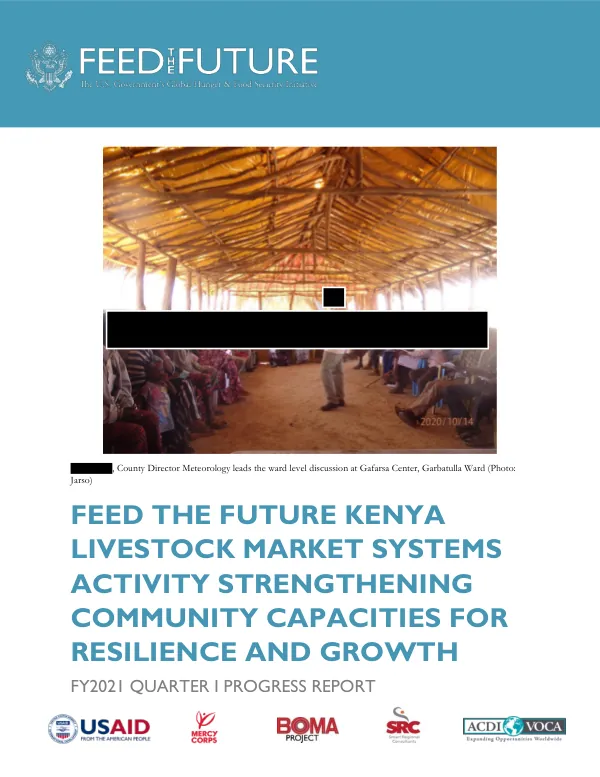
FEED THE FUTURE KENYA LIVESTOCK MARKET SYSTEM ACTIVITY STRENGTHENING COMMUNITY CAPACITIES FOR RESILIENCE AND GROWTH FY2021 QUARTER 1 PROGRESS REPORT
Sign inMERCY CORPS INTERNATIONAL
FEED THE FUTURE KENYA LIVESTOCK MARKET SYSTEM ACTIVITY STRENGTHENING COMMUNITY CAPACITIES FOR RESILIENCE AND GROWTH FY2021 QUARTER 1 PROGRESS REPORT
The Livestock Market System - Strengthening Community Capacities for Resilience and Growth (LMS-SCCRG) program is a USAID-funded initiative aimed at improving the livelihoods of rural communities in Kenya.
2021 · 49 pages
Sign in to readA free account is required to download.
Abstract
The program is implemented by Mercy Corps and its eight sub-awardees, including St Peter’s Community Network (SAPCONE) in Turkana, Wajir South Development Association (WASDA) and Rural Agency for Community Development and Assistance (RACIDA) in Wajir, Womankind Kenya (WOKIKE) and Rights Organization for Advocacy and Development (ROAD) in Garissa, Merti Integrated Development Program (MID-P) and Frontier Counties Development Council (FCDC) in Isiolo, and IDAI Africa in Isiolo. The program's objective is to strengthen the capacity of local partners to implement program activities, with a focus on ward-based development. The program has reached a total of 34 wards, exceeding the target of 24 wards. The local partner FCDC has provided technical support to county governments to develop the Ward Development Fund (WDF) and the Gender Socio-economic Empowerment Bill. The program has also launched research on Ward Planning (WDP) to support data-driven decision-making. The Ward Planning Committees (WPCs) have submitted concept notes for potential funding, and the program has received applications for community projects worth KES 1.5 billion, indicating a 102% utilization of the community grants portfolio. The program has worked closely with county governments to develop a Geographic Information System (GIS) to support County Development Information Systems (CDIS) with data-driven decision-making. The Wajir County government has allocated KES 10 million to start implementing the GIS action plan. The program has directly worked with approximately 66,690 individuals, including 17,166 adolescent girls and young women, 720 adolescent girl mentors, and a mixed group of 42,536 individuals targeted with WASH, Sanitation, and COVID-19 social behavior change communication. In this quarter, the program reached a total of 6,256 participants, including adolescent girls and boys through GIRL and those participating in ward-based development planning and WASH and COVID-19 social behavior communication. The program is expected to slow down its implementation tempo due to the upcoming elections, which may lead to conflict incidents. The program is working closely with all stakeholders to ensure the implementation of the WDF and the Gender Socio-economic Empowerment Bill. The program has already advertised the Deputy Chief of Party role and is fast-tracking the recruitment process. The transitions of the Chief of Party and Deputy Chief of Party roles will take place at the beginning of the next quarter. The program has made significant progress in its first quarter, exceeding its target of 24 wards and reaching a total of 34 wards. The program's focus on ward-based development has led to the development of the Ward Development Fund (WDF) and the Gender Socio-economic Empowerment Bill. The program's research on Ward Planning (WDP) has supported data-driven decision-making, and the program has worked closely with county governments to develop a Geographic Information System (GIS) to support County Development Information Systems (CDIS). The program's efforts to strengthen the capacity of local partners have led to the submission of concept notes for potential funding, and the program has received applications for community projects worth KES 1.5 billion. The program's focus on adolescent girls and young women has led to the direct work with approximately 66,690 individuals, including 17,166 adolescent girls and young women, 720 adolescent girl mentors, and a mixed group of 42,536 individuals targeted with WASH, Sanitation, and COVID-19 social behavior change communication. The program's progress in its first quarter has been significant, and it is expected to continue its efforts to strengthen the capacity of local partners and improve the livelihoods of rural communities in Kenya.
Related documents