USAID DEC
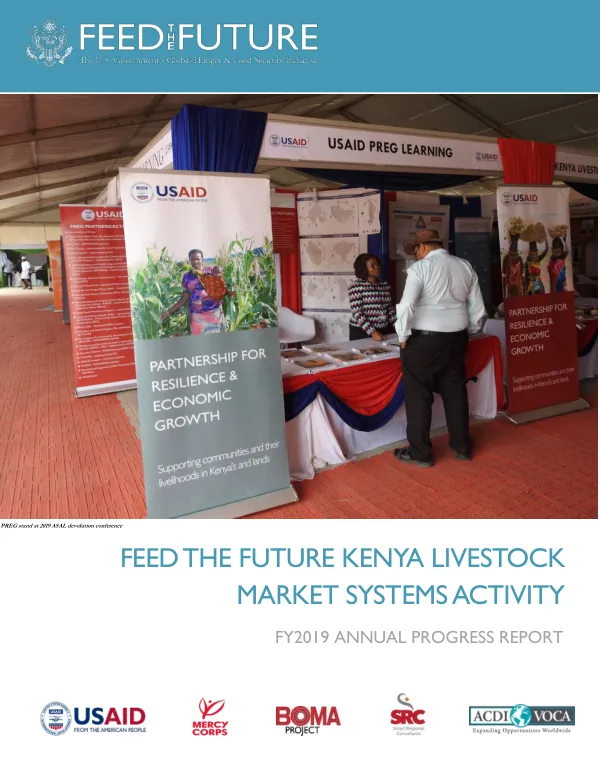
Feed the Future Kenya Livestock Market Systems Activity FY2019 Annual Progress Report
Sign inACDI/VOCA
Feed the Future Kenya Livestock Market Systems Activity FY2019 Annual Progress Report
The Feed the Future Kenya Livestock Market Systems Activity FY2019 Annual Progress Report outlines the achievements and progress of the program from October 2018 to September 2019.
2019 · 124 pages
Sign in to readA free account is required to download.
Abstract
The report is divided into three main sections: Leader Award, Expanding Economic Opportunities Award (AA1), and Strengthening Community Capacities Award (AA2). The Leader Award aimed to provide effective management and quality assurance, grants facilities management, PREG coordination and backbone support for collective impact and learning, and central support services. Key objectives included effective management and quality assurance, grants facilities management, PREG coordination, and central support services. The report highlights the progress made in these areas, including the establishment of a PREG coordination unit and the development of a grants management system. The Expanding Economic Opportunities Award (AA1) focused on expanding and diversifying viable economic opportunities in Kenya. The program aimed to facilitate more competitive, resilient, and inclusive livestock and related market systems, strengthen and diversify productive livelihood opportunities, and increase secure access to financial products and services. Key achievements included the facilitation of more competitive and resilient livestock market systems, the strengthening of productive livelihood opportunities, and the increase in secure access to financial products and services. The program also made progress in strengthening institutions, systems, and governance, including the development of a policy environment for the development of livestock and other market systems. Additionally, the program made progress in collaborative action and learning for market systems change, including the establishment of a learning and adaptation framework. The Strengthening Community Capacities Award (AA2) focused on strengthening community capacities, including the strengthening of institutions, systems, and governance, and the improvement of human capital. Key achievements included the strengthening of rangeland and water management, the strengthening of drought cycle management, and the improvement of health, nutrition, and hygiene practices. The program also made progress in collaborative action and learning for community empowerment, including the establishment of a sequencing, layering, and integration framework and the development of shared indicators and learning to support expanded economic opportunities. Overall, the report highlights the progress made by the program in achieving its objectives and making a positive impact on the lives of Kenyans. The program's achievements in expanding and diversifying viable economic opportunities, strengthening institutions, systems, and governance, and improving human capital demonstrate its commitment to reducing poverty and improving food security in Kenya. The program's progress in collaborative action and learning for market systems change and community empowerment also highlights its commitment to building the capacity of local institutions and communities to drive sustainable development. The report's focus on sustainability and exit strategies also demonstrates the program's commitment to ensuring that its achievements are sustained beyond the life of the program. The program's achievements in gender strategy, environmental mitigation and monitoring, and USAID Forward (J2SR) also demonstrate its commitment to addressing the needs of vulnerable populations and promoting sustainable development. The program's progress in links to other USAID programs and GOK agencies also highlights its commitment to collaboration and coordination with other stakeholders. Overall, the report provides a comprehensive overview of the program's achievements and progress, and highlights its commitment to reducing poverty and improving food security in Kenya.