DEPARTMENT OF AGRICULTURE
Provisional Plan for Coordination with the Government of Nepal
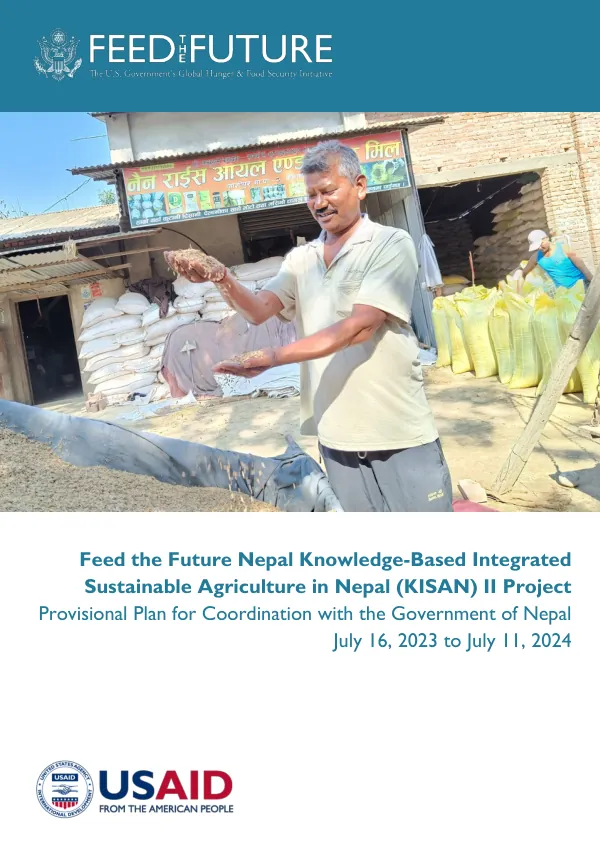
The Feed the Future Nepal Knowledge-Based Integrated Sustainable Agriculture in Nepal (KISAN) II Project was designed to align with and contribute to the goal of the Government of Nepal's (GON) Agriculture Development Strategy (ADS) and USAID's Feed the Future (FTF) Initiative.
2023 · 11 pages
Sign in to readA free account is required to download.
Abstract
The project successfully completed its five years of operation in 25 districts and has been continuing its operation for two additional years in eight districts under COVID-19 Supplemental Scope of Work (SSOW) and Additional Ukraine Supplemental Appropriation Act (AUSAA) SOW. KISAN II's coordination objectives with the GON are five-fold, contributing to systems-level impact. The project aims to align project priorities and activities to support the ADS and other policy priorities at the federal, provincial, and municipal levels of government through regular formal and informal meetings. The semi-annual Joint National Steering Committee (JNSC) of FTF projects, chaired by the Secretary, Ministry of Agriculture and Livestock Development (MOALD), and the Technical Committee (TC) of KISAN II, chaired by the Joint Secretary, Planning and Development Cooperation Coordination Division, MOALD, are the two important formal mechanisms at the federal level through which the project aligns its activities. The JNSC meetings are supplemented through activity-specific briefings and field visits to the project sites. The purpose of the JNSC is to ensure close coordination between the GON and FTF projects at all levels, update on implementation and monitoring progress, provide strategic guidance in program planning and implementation, share results, and resolve unsolved issues, and ensure stakeholder ownership and provide oversight to the process. To increase technical cooperation, knowledge sharing, and to address operational level issues, KISAN II convenes TC meetings. These meetings are organized semi-annually, close to the date of JNSC meetings wherever possible. The TC meetings bring together technical experts from MOALD, its departments, and other agencies, who collaborate with KISAN II technical experts and senior staff focusing on areas such as crop-specific practices, seeds and fertilizer, mechanization, post-harvest operations, marketing, irrigation, finance, environmental management, and/or private sector-led models, and policy agendas. KISAN II also coordinates with GON and other development partner activities at the federal, provincial, and local levels. The project assists and participates in regular periodic meetings with federal, provincial, and municipal organizations and interacts formally and informally with the officials working in the agriculture sector, with other government officials, and the elected representatives. Regular planning and coordination meetings are carried out with local/cluster level staff of sister projects, such as Nepal Seed and Fertilizer, FTF Nepal Integrated Pest Management, and Cereal Systems Initiative for South Asia. The project collaborates with GON officials at the federal, provincial, and municipal levels, field-level extension staff, and technical experts in joint training events and monitoring visits to ensure transparency and identification of opportunities for further collaboration. The collaboration with GON organizations helps adoption and sustainability of private sector-led models and best practices in the GON system. KISAN II also leverages provincial and local government funds for cost sharing in crop production activities, replicating the project's validated best practices and business models, such as the rice mill model, machinery support, and infrastructure development. Furthermore, KISAN II informs and influences key government stakeholders on market systems approaches and private sector engagement for a vibrant enabling environment for agricultural development. The project's coordination objectives and activities are designed to contribute to systems-level impact and support the GON's ADS and FTF Initiative.
Related documents