USAID DEC
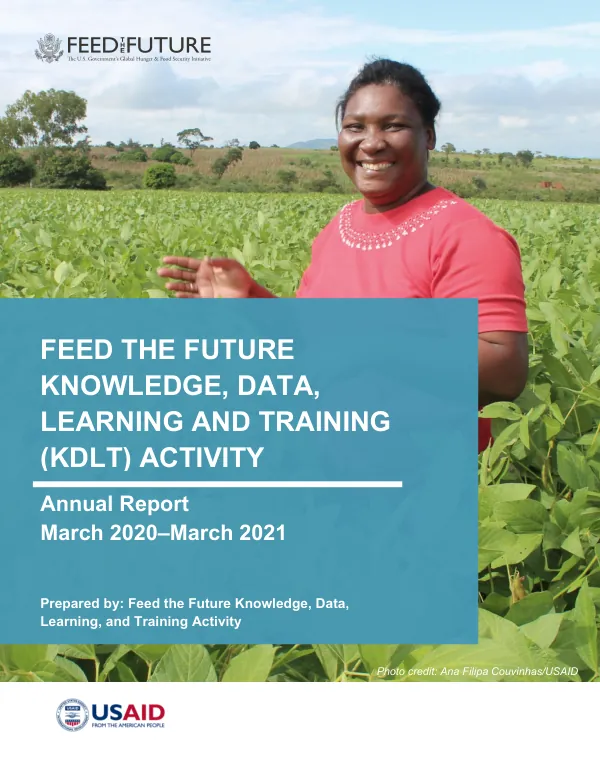
Feed the Future Knowledge, Data, Learning and Training (KDLT) Activity: Annual Report, March 2020-March 2021
Sign inINTERNATIONAL FOOD AND POLICY RESEARCH INSTITUTE
Feed the Future Knowledge, Data, Learning and Training (KDLT) Activity: Annual Report, March 2020-March 2021
The Feed the Future Knowledge, Data, Learning, and Training Activity (KDLT) expanded its services to support the United States Agency for International Development (USAID) Bureau for Resilience and Food Security (RFS) in conducting high-quality knowledge sharing, data analysis, and organizational learning and development.
2021 · 32 pages
Sign in to readA free account is required to download.
Abstract
KDLT's foundation in adaptive and Agile principles enabled the activity to make rapid and effective adjustments with USAID to ensure consistency and growth of services amidst the all-virtual COVID-19 context and RFS reorganization operating context. KDLT's efforts focused on five key results, including improved and sustained capacity to implement knowledge-sharing events and effective knowledge products. The activity expanded its use of existing online tools and added new ones to adapt all knowledge sharing, organizational learning, and training events to virtual platforms. KDLT supported all units across RFS with facilitated events focused on critical internal planning and team building within the new Bureau. The activity also pivoted from planning for a large overseas conference to supporting multiple external learning events with RFS and implementing partners. KDLT's work in expanding capacity for on-demand data analysis and visualization to support learning within Feed the Future (FTF) resulted in an increase in demand and delivery of data support activities. The activity provided RFS and project staff with monthly data monitoring reports via the KDLT Tableau dashboard. KDLT also worked with BHA to develop the Research Round-Up, a compilation of summaries of implementation and operations research designed to capture, synthesize, and disseminate research findings to all BHA staff to inform programming. In addition, KDLT made critical behind-the-scenes improvements and developments to the backend of the Agrilinks platform and more visibly through its targeted and strengthened outreach efforts and support to drive highly relevant content on the site. The activity acquired and began working with RFS's Center for Resilience (CR) on the ResilienceLinks website. To prepare for the formal relaunch of the site, KDLT facilitated important backend updates and drove user research and content strategy to align with the center's goals. KDLT's work across multiple work streams created opportunities to drive internal learning within RFS and with its partners. Agrilinks provided USAID and FTF implementing partners with opportunities to showcase and access rich stories of program learning and adaptation during the time of COVID-19, along with ongoing innovations and best practices in food security programming. KDLT piloted a new capacity strengthening and support model to RFS through an embedded, full-time Knowledge and Learning Specialist through the RFS Center for Agriculture. This model allowed for an expanded portfolio of support, such as the real-time integration of dynamic, innovative organizational learning tools. KDLT hosted pause-and-reflect sessions and supported RFS on multiple fronts with organizational development (OD) and process support, including the rollout of new Bureau retreats and the government-wide update to the Global Food Security Refresh led by RFS. KDLT also designed and facilitated six retreats with BHA. These retreats focused on issues related to organizational development and learning with several teams including the BHA Design, Monitoring and Evaluation and Applied Learning Division, the BHA Gender, Youth, and Social Dynamics team and the BHA Protection and Community Capacities Division. Overall, KDLT successfully completed its second year of program implementation to support USAID RFS. The activity's goal is to support RFS in becoming a premier learning organization that successfully captures, analyzes, and shares good practices and data, and uses this knowledge to learn and adapt, helping RFS to achieve its mission of improved nutrition, strengthened resilience, and reduced poverty in FTF countries.