USAID DEC
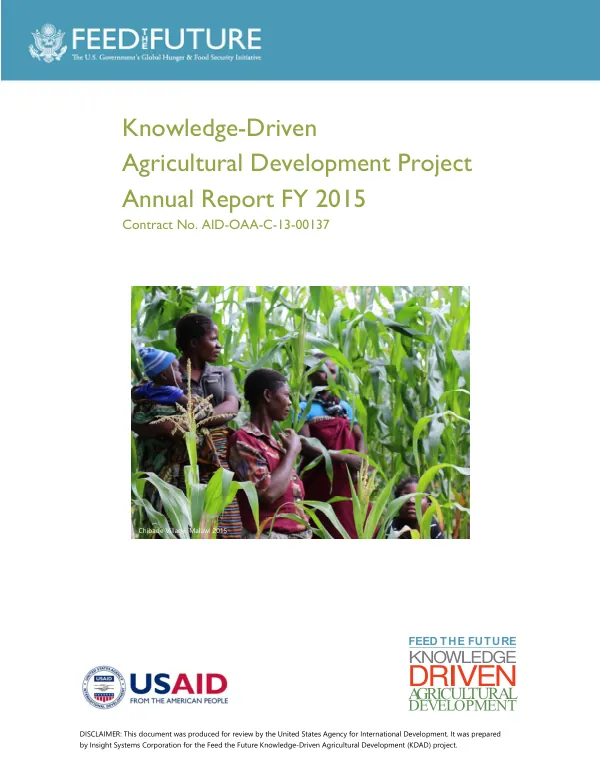
Feed the Future Knowledge-Driven Agricultural Development (KDAD) Annual Report FY 2015
Sign inINSIGHT SYSTEMS CORPORATION
Feed the Future Knowledge-Driven Agricultural Development (KDAD) Annual Report FY 2015
The Feed the Future Knowledge-Driven Agricultural Development (KDAD) project, funded by the Bureau for Food Security, began its activities in October 2013.
2015 · 34 pages
Sign in to readA free account is required to download.
Abstract
The project's purpose is to extend the knowledge management (KM) work of the successful Knowledge-Driven Microenterprise Development (KDMD) project and contribute to the understanding and practice of managing KM projects. Initially, KDAD focused on maintaining continuity with KDMD activities, but as the demand for services increased, a strategic approach evolved that linked content and engagement strategies and aligned with the Feed the Future Learning Agenda and other key themes of value to buy-in partners. KDAD operated through much of FY 2015 with three additional buy-ins: the Bureau for Economic Growth, Education and Environment (E3); Offices of Trade and Regulatory Reform (Microlinks Program) and Gender Equality and Women's Empowerment (GenDev Program); and the Bureau for Policy, Planning and Learning Office of Learning, Evaluation and Research (PPL/LER Program). Two additional initiatives were funded, including the development of an online training program for the USAID Center for Resilience and provision of webinar support for the Bureau for Democracy, Conflict and Humanitarian Assistance Office of U.S. Foreign Disaster Assistance (OFDA). At the end of the fiscal year, the E3 Bureau's new Office of Private Capital and Microenterprise (PCM Program) bought into the KDAD project seeking communications support. PCM expressed a need for development of a needs assessment and supporting communications strategy. Once complete, the strategy will guide activity development. KDAD recently completed its second year, a period of rapid growth for the project. During this time, KDAD expanded the use of technologies to improve communication and knowledge management and provided a greater level of service to a growing number of clients. In 2015, KDAD's web presence was larger than ever before, with more than 200,000 unique visits to its sites, generating more than 660,000 page views. The project's mailing lists and social media presence also grew significantly, reaching 30,000 subscribers and nearly 17,000 Twitter followers. KDAD's strong content helped drive engagement with several key audiences, including USAID offices and other development groups. The project cultivated strong relationships with 176 different organizations that contributed content to its sites and produced and hosted more than 1,200 new learning resources this year. KDAD's online training courses reached an important milestone, with more than 800 people visiting an online training module, an impressive 14 times more than in 2014. Courses covered topics like resilience, logical frameworks, and cost-benefit analysis. The modules are clean and easy to use, with a strong focus on actionable content that practitioners can apply, helping users build vital skills. KDAD is looking forward to improvements in year three that will help engage even more deeply with its community. The KDAD Performance Management, Monitoring and Evaluation Plan (PMMEP) for FY 2014 contained 34 project indicators. Of these, the team met or exceeded 18 targets, nearly completed 8, and did not achieve 5. Three targets were not applicable. The project's online training had the strongest performance, achieving 268 percent of the indicator target. Resilience and the Nutrition-Sensitive Agriculture indicators also showed strong performance, achieving 143 percent and 133 percent of the indicator targets, respectively.
Related documents