DAI GLOBAL, LLC
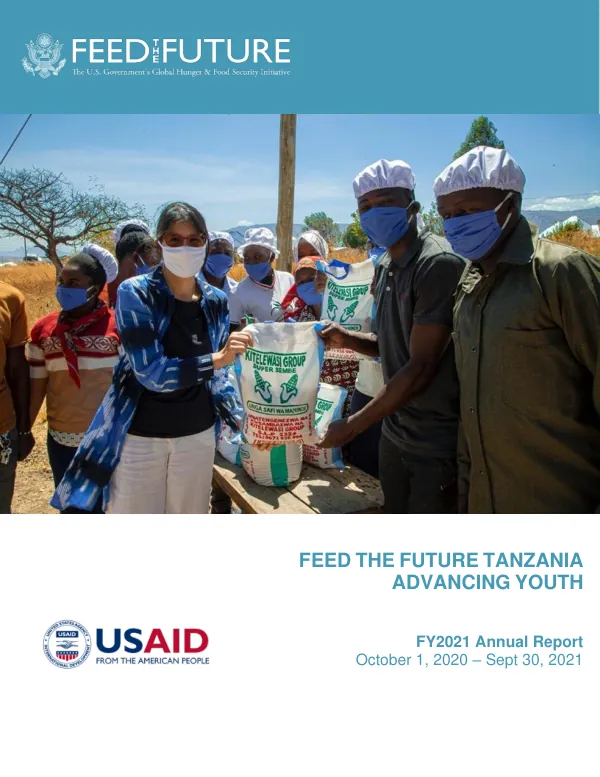
Feed the Future Tanzania Advancing Youth Annual Report FY2021
Feed the Future Tanzania Advancing Youth is a five-year project funded by the United States Agency for International Development (USAID) under the Youth Power IDIQ.
2021 · 97 pages
Sign in to readA free account is required to download.
Abstract
The project aims to leverage USAID/Tanzania's investments in employment, education, agriculture, governance, and health into one youth-centered project that builds the capacity of young people ages 15-35 and connects them to advancement opportunities. The project is implemented in three regions: Mbeya, Iringa, and Zanzibar. The project focuses on three main components: Increasing Entrepreneurship and Workforce-Readiness Skills of Youth, Strengthening Leadership and Positive Youth Development, and Life Skills for Healthy Living Enhanced. The project incorporates positive youth development (PYD) and gender-transformative approaches (GTA) into all its activities, ensuring that all youth are connected with economic opportunities while providing them with life skills, future goal orientation, an entrepreneurial mindset, and basic job-seeking capabilities in skill areas sought by the labor market. The project is implemented in collaboration with the Government of Tanzania and the Revolutionary Government of Zanzibar. The geographic coverage includes Iringa Municipal, Iringa DC, Kilolo, and Mufindi Districts in Iringa Region, Mbeya – Mbarali, Mbeya DC, Mbeya City, Busokelo, Rungwe, and Kyela Districts in Mbeya Region, and Unguja and Pemba Districts in Zanzibar. The project's reporting period is from October 1, 2020, to September 30, 2021. During this period, the project made significant progress in implementing its activities, including training over 2,500 youth in entrepreneurship and workforce-readiness skills, establishing demonstration plots to promote sustainable agriculture practices, and providing life skills training to over 1,000 youth. The project also made progress in strengthening leadership and positive youth development, including establishing a youth advisory council and providing training to over 500 youth leaders. Additionally, the project implemented life skills for healthy living enhanced activities, including training over 1,000 youth in healthy living practices and providing support to over 500 youth to access healthcare services. The project's geographic focus is on the three regions of Mbeya, Iringa, and Zanzibar, with a specific focus on the districts of Iringa Municipal, Iringa DC, Kilolo, and Mufindi in Iringa Region, Mbeya – Mbarali, Mbeya DC, Mbeya City, Busokelo, Rungwe, and Kyela in Mbeya Region, and Unguja and Pemba in Zanzibar. The project's timeframes are from August 17, 2017, to August 16, 2022, with a reporting period from October 1, 2020, to September 30, 2021. The project's recommendations include scaling up the project's activities to reach more youth, strengthening partnerships with local organizations, and increasing the project's focus on gender-transformative approaches. The project's implementation details include the use of a variety of training methods, including on-the-job training, classroom training, and mentorship. The project also uses a range of monitoring and evaluation tools, including surveys, focus groups, and key informant interviews, to track its progress and identify areas for improvement. The project's geographic context is characterized by a high youth population, with over 60% of the population under the age of 25. The project's focus on youth development is critical to addressing the challenges facing Tanzania's youth, including high unemployment rates, limited access to education and training, and limited economic opportunities. The project's recommendations for future implementation include scaling up the project's activities to reach more youth, strengthening partnerships with local organizations, and increasing the project's focus on gender-transformative approaches. The project's implementation details, including its use of training methods and monitoring and evaluation tools, will be critical to achieving its goals and making a lasting impact on the lives of Tanzania's youth.