USAID DEC
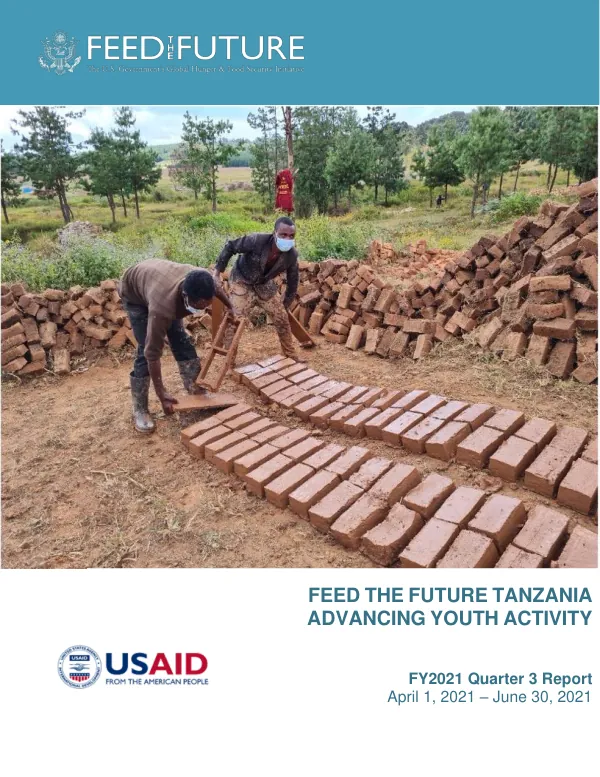
Feed the Future Tanzania Advancing Youth | FY 2021 Quarter 3 Report – April 1, 2021 – June 30, 2021
Sign inDAI GLOBAL, LLC
Feed the Future Tanzania Advancing Youth | FY 2021 Quarter 3 Report – April 1, 2021 – June 30, 2021
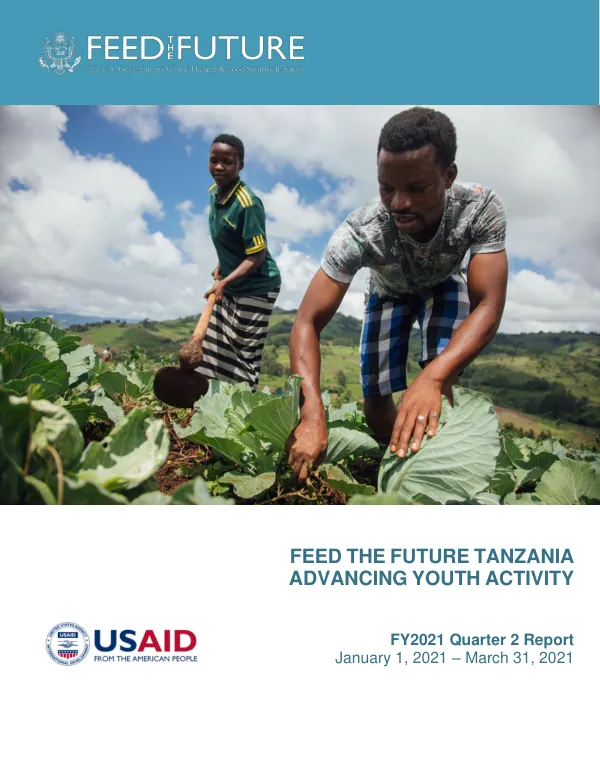
Feed the Future Tanzania Advancing Youth is a five-year project funded by the United States Agency for International Development (USAID) that aims to leverage investments in employment, education, agriculture, governance, and health into a youth-centered project.
2021 · 66 pages
Sign in to readA free account is required to download.
Abstract
The project seeks to build the capacity of young people in Tanzania to become productive and self-sufficient members of their communities. The project is implemented by DAI Global, LLC, with subcontractors Pathfinder International and DevWorks, and is supported by the Government of Tanzania and the Revolutionary Government of Zanzibar. The project focuses on three main components: leadership, economic empowerment, and health. The leadership component aims to build the capacity of young people to become leaders in their communities, while the economic empowerment component focuses on providing young people with the skills and resources they need to start their own businesses and become economically self-sufficient. The health component focuses on improving the health and well-being of young people, particularly in the areas of reproductive health and HIV/AIDS. The project operates in three regions of Tanzania: Iringa, Mbeya, and Zanzibar. In Iringa, the project focuses on supporting young people in the districts of Iringa, Mufindi, Iringa Municipal, and Kilolo. In Mbeya, the project focuses on supporting young people in the districts of Rungwe, Busokelo, Mbeya, Mbeya Council, Mbeya City Council, Mbarali, and Kyela. In Zanzibar, the project focuses on supporting young people on the Unguja and Pemba islands. During the reporting period of April 1, 2021, to June 30, 2021, the project made significant progress in implementing its activities. The project trained over 2,500 young people in leadership and entrepreneurship skills, and provided over 1,000 young people with access to financial services and business training. The project also supported the establishment of several youth-led businesses and cooperatives, and provided over 500 young people with access to reproductive health services. The project's monitoring and evaluation system is designed to track progress towards its goals and objectives. The system includes a range of indicators, including the number of young people trained, the number of businesses established, and the number of young people accessing reproductive health services. The project's evaluation team conducts regular assessments of the project's progress and provides recommendations for improvement. The project has also made significant progress in integrating cross-cutting issues, including gender, environment, and local capacity development. The project has established a gender advisory committee to ensure that the project's activities are responsive to the needs of young women and girls. The project has also established a community-based environmental monitoring system to track the project's environmental impact. The project has also made significant progress in government and stakeholder engagement. The project has established a range of partnerships with government agencies, civil society organizations, and private sector companies to support the project's activities. The project has also established a range of communication channels to keep stakeholders informed about the project's progress and activities. In terms of management and administrative issues, the project has made significant progress in implementing its COVID-19 prevention protocols. The project has established a range of measures to prevent the spread of COVID-19, including the provision of personal protective equipment, the implementation of social distancing measures, and the provision of COVID-19 testing and treatment services. The project has also made significant progress in financial management. The project has established a range of financial management systems to track the project's expenses and ensure that funds are used efficiently and effectively. The project has also established a range of financial reporting systems to provide stakeholders with regular updates on the project's financial performance. Overall, the Feed the Future Tanzania Advancing Youth project has made significant progress in implementing its activities and achieving its goals and objectives. The project has built the capacity of young people in Tanzania to become productive and self-sufficient members of their communities, and has improved the health and well-being of young people, particularly in the areas of reproductive health and HIV/AIDS.