FINTRAC
USAID-TAPP monthly bulletin #28
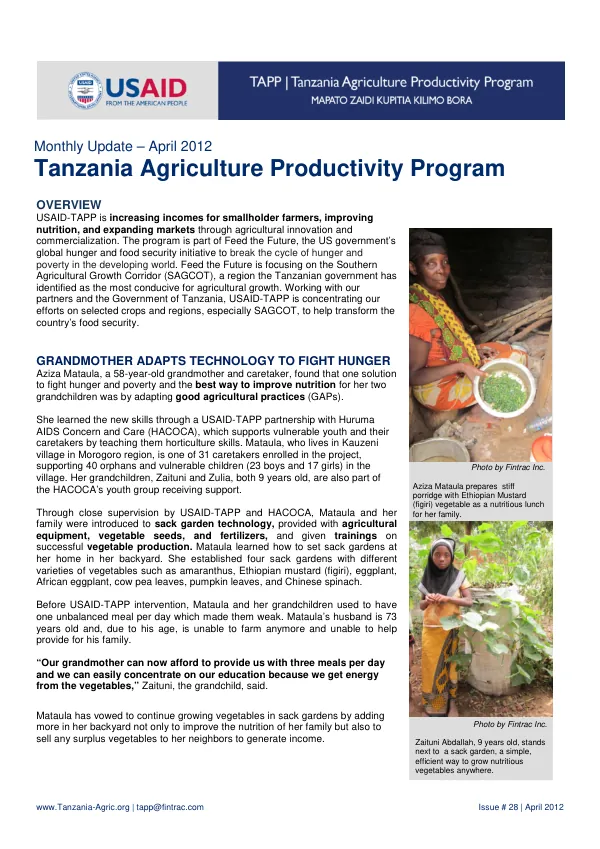
The Tanzania Agriculture Productivity Program (TAPP) is a USAID-funded initiative aimed at increasing incomes for smallholder farmers, improving nutrition, and expanding markets through agricultural innovation and commercialization.
2012 · 2 pages
Sign in to readA free account is required to download.
Abstract
The program is part of the US government's global hunger and food security initiative, Feed the Future, which focuses on the Southern Agricultural Growth Corridor (SAGCOT) in Tanzania. SAGCOT has been identified by the Tanzanian government as the most conducive region for agricultural growth. TAPP is working with partners and the Government of Tanzania to concentrate efforts on selected crops and regions, particularly SAGCOT, to help transform the country's food security. The program is supporting smallholder farmers in adopting good agricultural practices (GAPs) and improving their productivity through training and provision of agricultural equipment, seeds, and fertilizers. One such farmer is Aziza Mataula, a 58-year-old grandmother and caretaker, who has successfully adapted GAPs to improve nutrition for her two grandchildren. Mataula, who lives in Kauzeni village in Morogoro region, was enrolled in a project supported by USAID-TAPP and Huruma AIDS Concern and Care (HACOCA), which teaches horticulture skills to vulnerable youth and their caretakers. Through close supervision by USAID-TAPP and HACOCA, Mataula and her family were introduced to sack garden technology, provided with agricultural equipment, vegetable seeds, and fertilizers, and given trainings on successful vegetable production. Mataula established four sack gardens with different varieties of vegetables and has seen significant improvements in her family's nutrition and income. Another successful smallholder farmer is Idd Seif, a 51-year-old farmer from Lukozi village in Lushoto district, Tanga region. Seif was assisted by USAID-TAPP with agricultural training in greenhouse technology and has shown great harvest results from his greenhouse plot. His successes have impressed many, including a Dutch vegetable breeding company, Rijk Zwaan, which has promised to assist him with tomato hybrid seeds for his next planting season. Seif's greenhouse plot has yielded a total of 4,840 kilograms of hybrid tomatoes, with a profit of Tshs. 6,453,333 (US $4,059) expected for the remainder of the season. USAID-TAPP is also partnering with Business Planet, a local agribusiness established in 2007, to scale-up its operation by expanding both its production and customer base. The company will integrate 255 new growers into a chili and vegetable outgrower scheme, providing them with training in GAPs and access to quality planting materials. The farmers are expected to increase their yields by 60 percent and earn collective profit of $211,000. Business Planet will grade and pack the smallholder-produced crops at Mailer Farm, which was previously supported under the USAID-SHOP program.
Related documents