USAID DEC
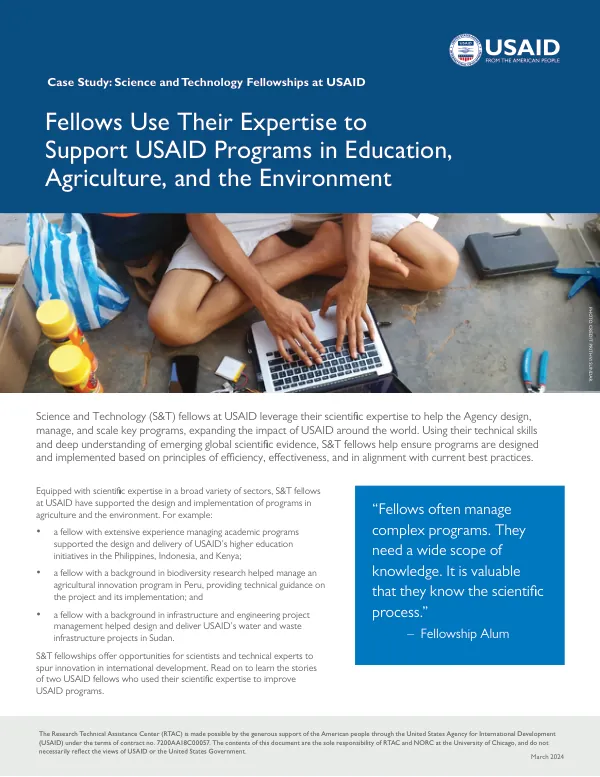
Fellows Use Their Expertise to Support USAID Programs in Education, Agriculture, and the Environment
Sign inFOOD AND AGRICULTURE ORGANIZATION OF THE UNITED NATIONS IN GEORGIA
Fellows Use Their Expertise to Support USAID Programs in Education, Agriculture, and the Environment
The Science and Technology Fellowships at USAID leverage the expertise of scientists and technical experts to support the Agency's programs in various sectors, including education, agriculture, and the environment.
2024 · 2 pages
Sign in to readA free account is required to download.
Abstract
Fellows contribute to the design, implementation, and scaling of key programs, ensuring that they are efficient, effective, and aligned with best practices. Fellows with diverse backgrounds in science and technology sectors have supported the design and implementation of programs in agriculture and the environment. For example, a fellow with extensive experience in managing academic programs supported the design and delivery of USAID's higher education initiatives in the Philippines, Indonesia, and Kenya. Another fellow with a background in biodiversity helped manage an agricultural innovation program in Peru, providing technical guidance on the project and its implementation. The Science and Technology Fellowships offer opportunities for scientists and technical experts to contribute to innovation in international development. Fellows have used their expertise to support USAID programs, including the Feed the Future initiative, which aims to improve agricultural productivity and food security in developing countries. Fellows have also contributed to the design and implementation of programs in the environment sector, including initiatives to address climate change and promote sustainable development. Shelie Miller, a Jefferson Science Fellow Alum, contributed to USAID's work on climate change during her fellowship between 2016 and 2017. Miller, an environmental engineer and professor of environment and sustainability systems, drew on her research on potential unintended environmental consequences of emerging technologies and energy systems. She provided oversight and guidance on the environmental review of innovations in development and contributed to initiatives that match USAID-supported innovations with potential adopting partners. Emma Bratton, a DVM and AAAS Science and Technology Policy Fellow Alum, helped USAID expand its impact in the agriculture and livestock sectors during her fellowship in 2022-2023. Bratton, a veterinary science expert, led a learning exercise on the Feed the Future initiative and helped tackle biases against livestock programs in low- and middle-income countries. She also contributed to the development of USAID's Biodiversity Policy and served as a leader of the One Health Working Group. The Science and Technology Fellowships have enabled fellows to apply their expertise to various policy challenges and contribute to the design and implementation of USAID programs. Fellows have used their skills to support the Agency's work in education, agriculture, and the environment, and have made significant contributions to the development of innovative solutions to global challenges.
Related documents