DT GLOBAL
Female Empowerment in Action: Data.FI IMPACT STORY
The digital revolution has been far from equitable, with over one-third of all women lacking internet access and representing less than 30 percent of the global tech sector workforce.
2023 · 6 pages
Sign in to readA free account is required to download.
Abstract
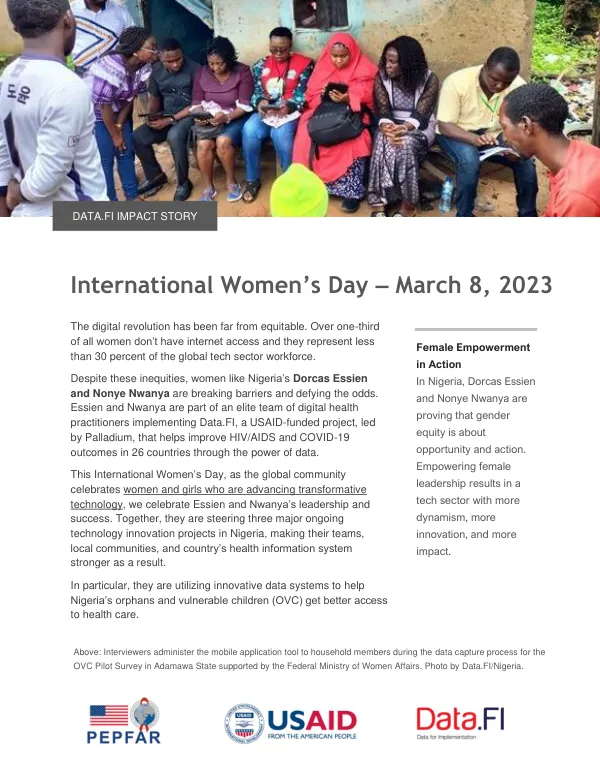
Despite these inequities, women like Nigeria's Dorcas Essien and Nonye Nwanya are breaking barriers and defying the odds. Essien and Nwanya are part of an elite team of digital health practitioners implementing Data.FI, a USAID-funded project led by Palladium, that helps improve HIV/AIDS and COVID-19 outcomes in 26 countries through the power of data. Data.FI's impact story highlights the work of Essien and Nwanya in utilizing innovative data systems to help Nigeria's orphans and vulnerable children (OVC) get better access to healthcare. In Nigeria, Essien and Nwanya are proving that gender equity is about opportunity and action, empowering female leadership results in a tech sector with more dynamism, more innovation, and more impact. The National OVC Pilot Survey in Nigeria was held in six states and developed and implemented by Essien. The survey was designed to assess the prevalence and basic needs of OVC in Nigeria to guide decision-makers on how best to link these children to healthcare. The survey required a single software package to enable the entry, editing, tabulation, and dissemination of survey data collected on OVC in the six participating states. Essien chose the Census and Survey Processing System (CSPro) on a mobile architecture framework because it combined the features of the integrated microcomputer processing system (IMPS) and the integrated system for survey analysis (ISSA). Essien configured a data dictionary that established consistent meanings and relationships for the expected data, ensuring that each software form corresponded to that dictionary. She also used programming logics to design a robust mobile survey app to record survey responses quickly and easily. Once the technology was configured and prepared, Essien coordinated and supported the training of interviewers, data managers, and other stakeholders who would collect data on OVC. The data managers were trained on how to use the mobile app, profile and analyze the raw data, and troubleshoot the data collection tool in case anything went wrong in the field. Essien and her team provided around-the-clock technical support from a central control room set up in each state, ensuring that the data was collected quickly and effectively and then synced to the CSPro web server for further analysis and dissemination. The National OVC Management Information System (NOMIS) is a national electronic platform for the management of data for OVC programs in Nigeria. NOMIS was originally introduced in 2011 and is designed to support end-users as they care for OVC and their families. Essien and Nwanya helped design and develop the system when it came online and have led the charge for concerted efforts to improve the functionality of NOMIS and establish a stable, scalable architecture capable of meeting growing program demands. After an assessment conducted by Data.FI in September 2019 identified several gaps in NOMIS and various areas for improvement, Essien and Nwanya worked to implement innovative digital solutions, introducing more efficient operability, quality assurance checks, and improved reporting of program data. Lafiya Management Information System (LAMISPlus) is a re-platformed, open-source, modular electronic medical records system that enables all USAID implementing partners in Nigeria to link HIV client records through a facility-level interoperability layer and exchange those data with the National Data Repository. Nwanya is currently leading the ongoing deployment of LAMISPlus in 17 Nigerian states. Once fully operational, LAMISPlus will support both point-of-care services and retrospective data entry along with the standard of health facility workflow, enabling health providers to track clients across the continuum of care and ensure that antiretroviral treatment is consistently received.