USAID DEC
FHI 360’s COVID-19 Infection Prevention through Community Engagement Semi Annual Report
Sign inFHI 360
FHI 360’s COVID-19 Infection Prevention through Community Engagement Semi Annual Report
The COVID-19 Infection Prevention through Community Engagement project in the Democratic Republic of the Congo (DRC) aims to decrease the risk of infection among vulnerable populations through risk communication and community engagement (RCCE) messaging and community outreach.
2020 · 12 pages
Sign in to readA free account is required to download.
Abstract
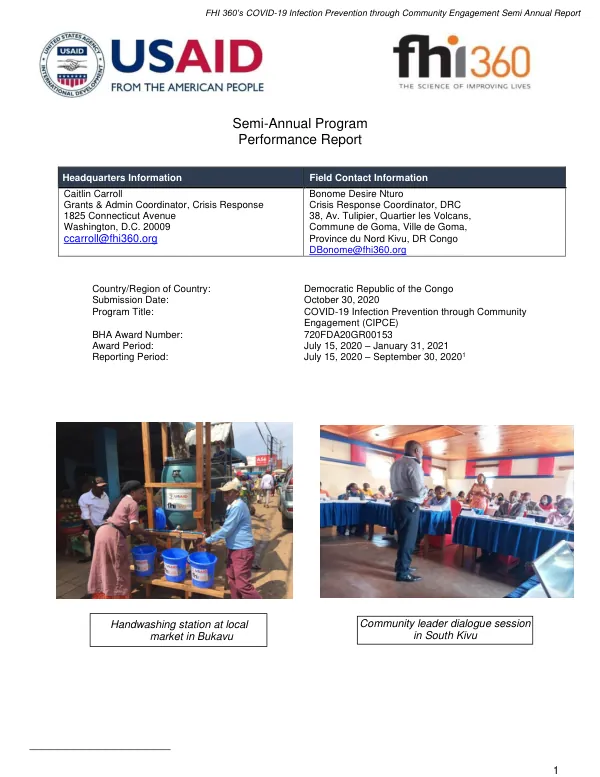
The project targets 2,431,587 individuals, including 309,258 internally displaced persons (IDPs), in ten health zones across North Kivu and South Kivu provinces. As of the end of the reporting period, the DRC had reported 11,253 total cases of COVID-19, including 305 deaths, with a mortality rate of 2.7%. North Kivu has seen the largest increase in cases, with 897 reported over the last two and a half months, while South Kivu has reported 45 new cases. However, limited access to testing materials has resulted in low testing capacity, with approximately 100-200 tests administered per day. To address the pandemic, FHI 360 has implemented a community-based approach focused on RCCE, empowering local communities to protect themselves from infection. The project has conducted numerous meetings and engagement sessions with health authorities to sign memorandums of understanding (MOUs) and create buy-in at the provincial, health zone, and health area levels. Project staff have also facilitated further engagement sessions to identify community health workers (CHWs), or Relais Communautaires (RECOs), to spread preventative messaging to reduce the risk of transmission among vulnerable populations. To date, RECOs from seven of the ten targeted health zones have completed trainings on RCCE, surveillance, and hygiene promotion, preparing them to spread messaging and identify suspect cases of COVID-19 in their communities. The RECOs have begun surveillance and messaging activities in their respective health zones. Additionally, FHI 360 has identified 11 radio stations and community/traditional leaders across North Kivu and Ituri to participate in the production and dissemination of radio programming, collaborating with these leaders to create call-in shows on local radio stations to increase community understanding and dispel rumors surrounding COVID-19. The CIPCE project also has a complementary WASH component focused on hygiene promotion. During the reporting period, the project assumed responsibility for 39 handwashing stations and seven points of entry (PoE) at checkpoints and other highly trafficked points in urban and peri-urban settings, paying particular attention to reaching groups at heightened risk due to COVID-19. CHW/Vs supervise these public handwashing stations that feature loudspeakers to spread pre-recorded health messaging to individuals passing through these locations. Additionally, FHI 360 identified high-risk households for distributing handwashing NFIs designed to improve hygiene practices in these homes and launched the procurement process. The project has met numerous challenges in terms of launching activities, including difficulties associated with starting a project in South Kivu, a new territory for FHI 360's Crisis Response, expectations by some participants and authorities for monetary compensation to participate or promote activities, and access issues related to ongoing conflict and road conditions. However, the CIPCE project has been able to overcome these obstacles and launch programming throughout target areas through continued engagement with health authorities and beneficiaries. The project's objectives are to decrease the risk of infection of COVID-19 among vulnerable populations in the DRC through RCCE messaging and community outreach. The project has made significant progress in increasing community acceptance and preventing transmission amongst at-risk communities, leveraging existing networks of community engagement actors to prevent and respond to the spread of COVID-19.