FHI 360
Scaling Up Ebola Response through Community Engagement Semi Annual Report
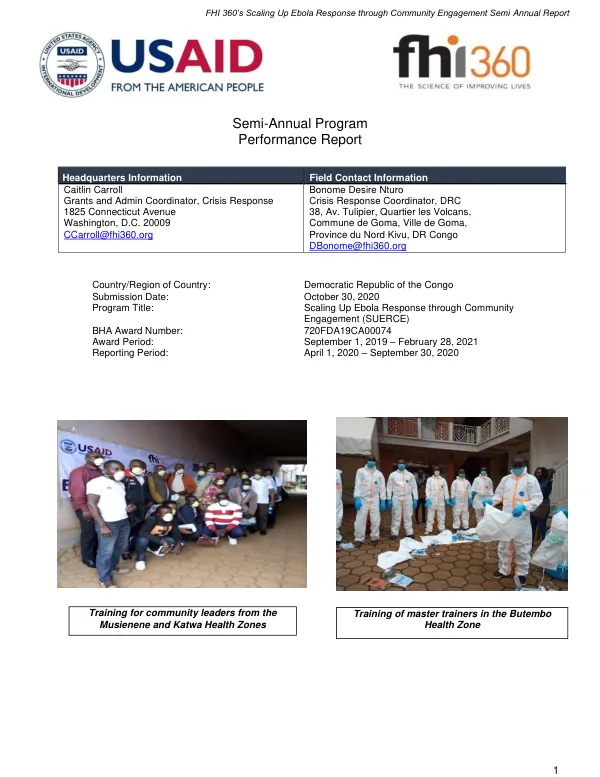
The SUERCE project, implemented by FHI 360 in the eastern regions of the Democratic Republic of the Congo (DRC), aimed to support the overall Ebola Virus Disease (EVD) response through two main pillars: Social Mobilization and Community Engagement (SMCE) and Safe and Dignified Burial (SDB).
2020 · 21 pages
Sign in to readA free account is required to download.
Abstract
The project, which began on September 1, 2019, and covered the period between September 1, 2019, and March 31, 2020, focused on engaging local and traditional leadership to create acceptance and promote locally owned and led response activities. At the onset of the project, the EVD outbreak had already experienced a total of 3,036 cases reported, with 2,035 proving fatal (fatality ratio of 67%). The outbreak was the largest of the ten recorded EVD outbreaks in the history of the DRC and the second largest ever recorded worldwide. Despite the difficult and insecure operating environment in the Eastern DRC, FHI 360's teams successfully adapted to the shifting situation on the ground, and the EVD outbreak was slowly brought under control. The SUERCE project expanded its SDB and SMCE activities from the 13 Health Zones covered under the RREDRC project to include a total of 20 Health Zones across Ituri and North Kivu Provinces. FHI 360 continued its planned activities while remaining flexible to the needs of the response. For SDB activities, FHI 360 identified new health zones threatened by the outbreak, trained and supported new teams in at-risk communities, and took over coffin supply and grave digging activities when the previous actors were unable to continue. FHI 360's SMCE teams adapted programming to fit new areas and needs, worked to build new relationships with traditional leaders and communities, and expanded efforts to include community-based surveillance in order to identify potential cases of EVD and other major diseases. Over this time, FHI 360 EVD response teams were confronted by a wide set of challenges, including rapid territorial changes of the outbreak into access-constrained areas, volatile operating environments, and difficulties associated with scaling down the response in areas that have become accustomed to income-generating activities related to the Ebola response. Despite these difficulties, FHI 360 is on track to meet its objectives and see the end of the Ebola outbreak in the coming months. The project's commitment to its two-pronged approach, which espouses the engagement of traditional leaders and communities, has been instrumental in promoting locally owned and led response activities and increasing community acceptance for the response. The SUERCE project also added 'wraparound' activities in the sectors of Economic Recovery and Market Systems (ERMS) and Water, Sanitation and Hygiene (WASH) targeted at hard-hit communities that have demonstrated high levels of community resistance. These sectors are designed to be complementary to FHI 360's main response activities and increase community acceptance for the response through life skills and vocational trainings, water source rehabilitation, and hygiene promotion. FHI 360's teams have continued to find ways to work in unstable regions known for high levels of distrust and insecurity through its effective community engagement strategy. The project has also adjusted its programming to shifting response needs, changing sources of community resistance, competing influences in the overall response coordination, and difficulties associated with scaling down the response in areas that have become accustomed to income-generating activities related to the Ebola response. The worldwide Covid-19 pandemic began to further complicate this already difficult operating environment towards the end of the reporting period. However, FHI 360 remains committed to its objectives and is on track to meet them, with the end of the Ebola outbreak in the coming months a direct result of its commitment to its two-pronged approach.