FHI 360
FHI 360’s Scaling Up Ebola Response through Community Engagement Semi Annual Report
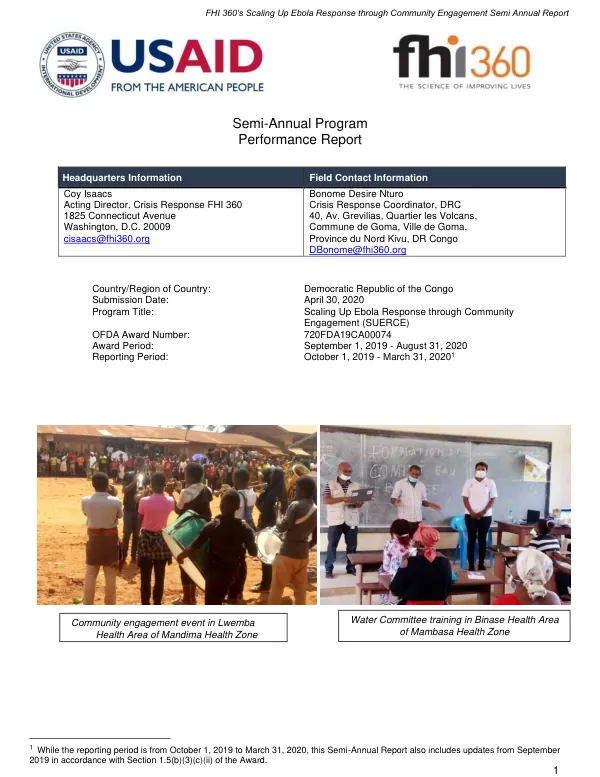
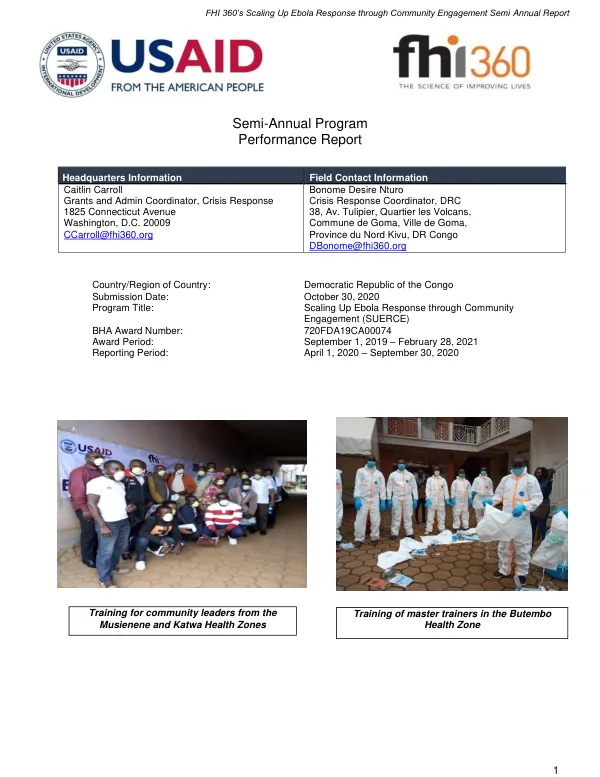
The SUERCE project in the Democratic Republic of the Congo (DRC) continued to support the Eastern DRC's Ebola Virus Disease (EVD) response through the two pillars of Social Mobilization and Community Engagement (SMCE) and Safe and Dignified Burial (SDB).
2020 · 22 pages
Sign in to readA free account is required to download.
Abstract
The project implemented WASH activities, including hygiene promotion, Infection Protection and Control (IPC) support in health facilities, and rehabilitation of water sources. These activities complemented the SDB and SMCE components by increasing community acceptance and knowledge of prevention and transmission of EVD. The SUERCE project supported SDB and SMCE activities in 17 health areas across Ituri and North Kivu Provinces. The project continued to adapt to the needs of the response, including addressing community resistance and new challenges from COVID-19. Despite obstacles, the project met or exceeded most indicator targets and implemented activities to end the 10th EVD outbreak and prepare for future outbreaks. The project's strategy engaged with traditional and community leaders to create acceptance and promote response activities. This approach helped bring an end to the outbreak, prompting authorities to request the project to replicate its response to the 11th EVD outbreak in Equateur Province. The SUERCE project's success in leveraging its influence and relationships with traditional and community leadership structures contributed to the control of the EVD outbreak. The project's ability to adapt to the needs of the response and address community resistance and new challenges from COVID-19 demonstrated its effectiveness in responding to complex public health emergencies. The project's WASH activities, including hygiene promotion, IPC support, and rehabilitation of water sources, increased community acceptance and knowledge of prevention and transmission of EVD. The project's focus on community engagement and ownership helped bring an end to the outbreak and prepared for future outbreaks. The SUERCE project's achievements in the DRC demonstrate its commitment to responding to complex public health emergencies. The project's ability to adapt to the needs of the response and address community resistance and new challenges from COVID-19 highlights its effectiveness in responding to complex public health emergencies. The project's success in engaging with traditional and community leaders and creating community ownership in the response helped bring an end to the outbreak. The project's ability to replicate its response to the 11th EVD outbreak in Equateur Province demonstrates its effectiveness in responding to complex public health emergencies. The project's focus on community engagement and ownership helped bring an end to the outbreak and prepared for future outbreaks. The project's success in engaging with traditional and community leaders and creating community ownership in the response helped bring an end to the outbreak. The SUERCE