USAID DEC
Field Performance of Bt Eggplants (Solanum melongena L.) in the Philippines: Cry1Ac Expression and Control of the Eggplant Fruit and Shoot Borer (Leucinodes orbonalis Guenée)
Sign inUSAID DEC
Field Performance of Bt Eggplants (Solanum melongena L.) in the Philippines: Cry1Ac Expression and Control of the Eggplant Fruit and Shoot Borer (Leucinodes orbonalis Guenée)
Bt Eggplant Development in the Philippines The development of Bt eggplant in the Philippines is a significant initiative aimed at controlling the eggplant fruit and shoot borer (EFSB), a major constraint to eggplant production in the country.
2016 · 22 pages
Sign in to readA free account is required to download.
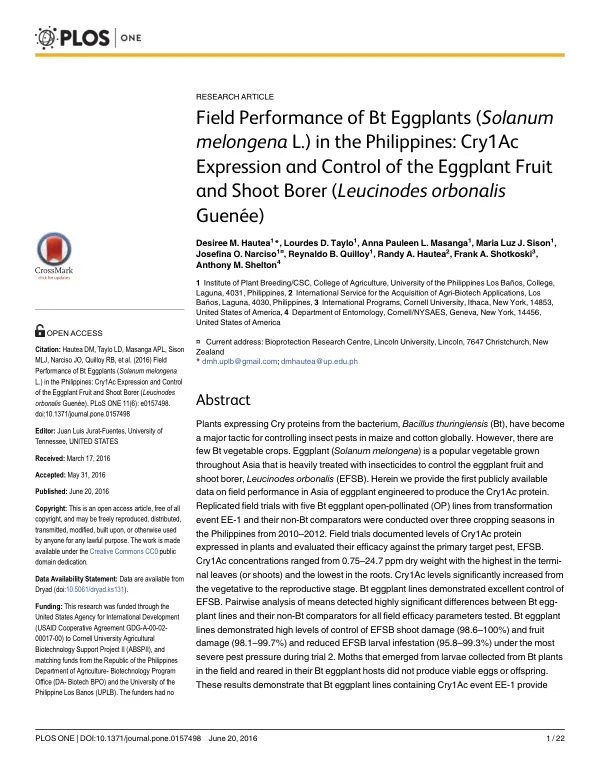
Abstract
The EFSB causes significant damage to eggplant crops, resulting in yield loss of up to 80% at high pest pressure. To address this issue, researchers have focused on developing Bt eggplant that expresses the Cry1Ac protein, which has been successfully used in cotton to control insect pests. The Cry1Ac protein is derived from the bacterium Bacillus thuringiensis (Bt) and has been shown to be effective in controlling several major insect pests, including the EFSB. The protein works by binding to the insect's midgut, causing the insect to die. In the Philippines, the Cry1Ac protein has been introduced into eggplant varieties through conventional backcrossing, coupled with diagnostic EE-1 event-specific PCR and a cry1Ac gene strip assay. Field trials were conducted in the Philippines to evaluate the expression levels of Cry1Ac protein in Bt eggplant open-pollinated (OP) lines and to assess the field efficacy of the EE-1 event in controlling EFSB. The trials were conducted over three cropping seasons from 2010 to 2012 and involved replicated field trials with five Bt eggplant OP lines from transformation event EE-1 and their non-Bt comparators. The results of the field trials showed that the Bt eggplant lines demonstrated excellent control of EFSB, with high levels of control of EFSB shoot damage (98.6-100%) and fruit damage (98.1-99.7%) and reduced EFSB larval infestation (95.8-99.3%) under the most severe pest pressure during trial 2. The Bt eggplant lines also showed high levels of Cry1Ac protein expression, with concentrations ranging from 0.75-24.7 ppm dry weight. The study demonstrated that Bt eggplant lines containing the Cry1Ac protein event EE-1 provide a promising solution for controlling EFSB in the Philippines. The results of the study have significant implications for the development of Bt eggplant as a tool for integrated pest management (IPM) in the country. The use of Bt eggplant could dramatically reduce the need for conventional insecticides, which are often used to control EFSB and pose risks to human health and the environment. The development of Bt eggplant in the Philippines is a collaborative effort between the University of the Philippines Los Baños, the International Service for the Acquisition of Agri-Biotech Applications, and the Cornell University Agricultural Biotechnology Support Project II. The project was funded through the United States Agency for International Development (USAID) Cooperative Agreement GDG-A-00-02-00017-00 and matching funds from the Republic of the Philippines Department of Agriculture-Biotechnology Program Office and the University of the Philippines Los Baños. The study highlights the potential of Bt eggplant as a tool for controlling EFSB in the Philippines and demonstrates the effectiveness of the Cry1Ac protein event EE-1 in controlling the pest. The results of the study have significant implications for the development of Bt eggplant as a tool for IPM in the country and could contribute to the reduction of insecticide use and the improvement of eggplant yields.
Related documents