USAID. MISSION TO BOTSWANA
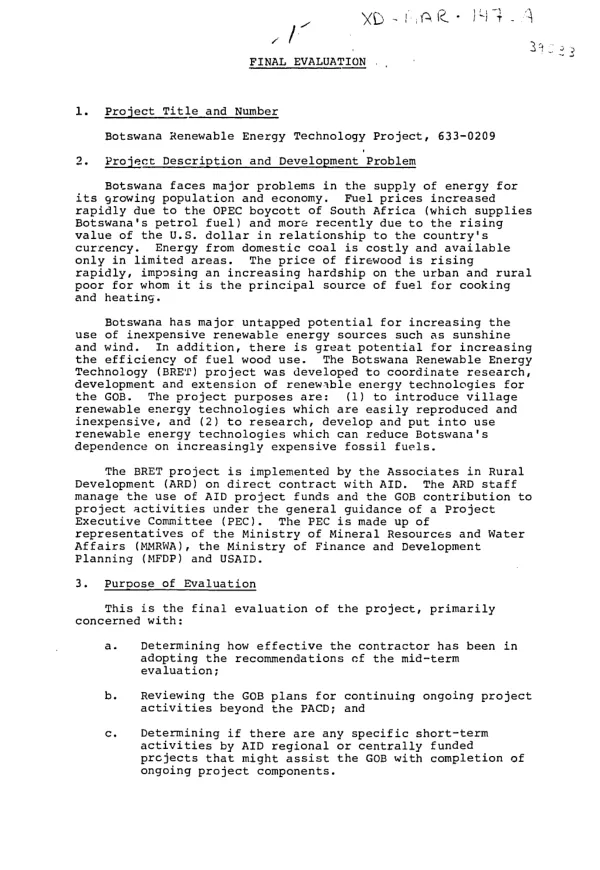
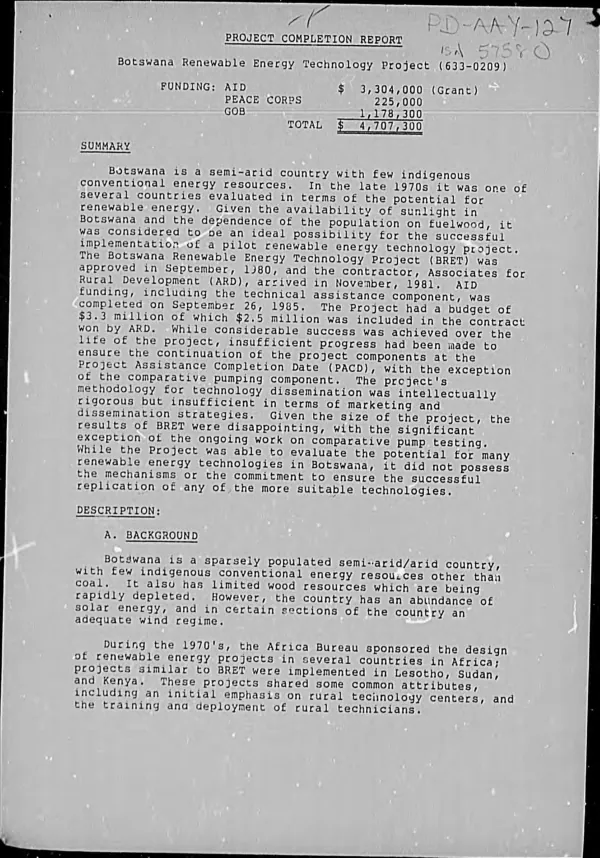
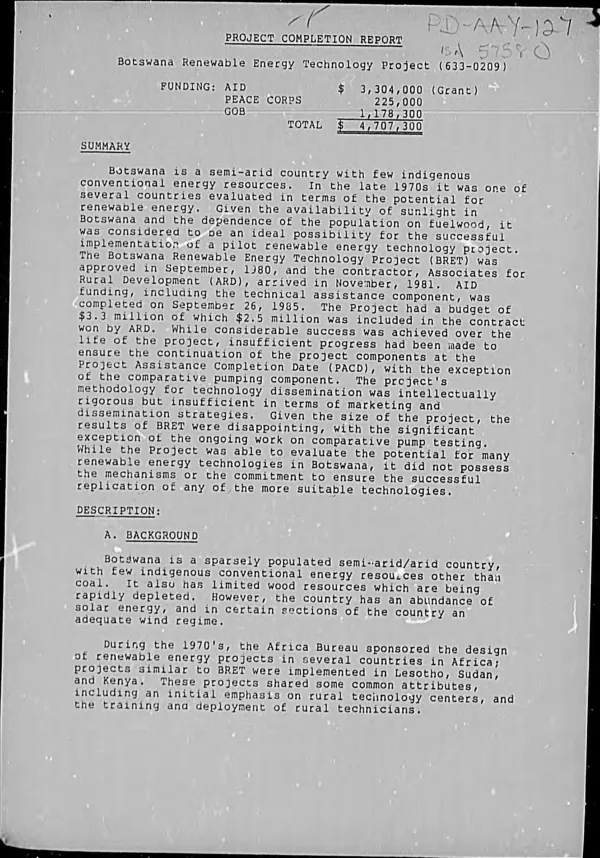
Final evaluation : Botswana renewable energy technology project, 633-0209
Evaluates pilot project to develop, test, and extend renewable energy technologies suitable to Botswanan villages.
1984
Sign in to readA free account is required to download.
Abstract
Final evaluation covers the period 1/84-4/85 and is based on document review, site visits, and interviews with project and Government of Botswana (GOB) staff and with participating villagers. Contrary to expectations, the project has demonstrated that there may be no satisfactory village-level renewable energy technologies applicable in Botswana. Although project R&D showed that significant fuelwood savings are available from metal cook stoves, retained heat cookers, batch solar water heaters, and mud stoves, none of these technologies have been successfully extended to villagers. Work on the mud stove was terminated due to problems with durability, quality control, and utilization, while traditional cooking and washing habits inhibited extension of retained heat cookers and solar water heaters. Metal stoves are of interest, but production, marketing, and affordability problems may be insurmountable. Renewable energy for water pumping appears more promising. Performance and cost data are being collected on wind, photovoltaic, biogas, animal and human traction, diesel, and electric pumping systems. Another 1-2 years of study will be needed to determine the economic feasibility of these options. The development of monitoring equipment for the pumping tests has been an important, unplanned project output, of potential use elsewhere in Africa. The contractor has tried to follow each recommendation in the mid-term evaluation and will meet or surpass almost all revised outputs. The most important issue still facing the project is the lack of definite plans for incorporating project activities into other GOB programs. It was learned that: (1) renewable energy technology pilot projects should be designed more clearly around end use topics and if possible incorporated into larger projects (e.g., agricultural research, housing) that address end use; (2) the project was too ambitious and based on questionable concepts (these errors were remedied during the 1/84 evaluation); and (3) projects should be revised to reflect changing conditions, even if changes result in implementation delays. Recommendations are reflected in the action decisions of the attached PES (PD-AAR-147).