DEVELOPMENT ASSOCIATES, INC.
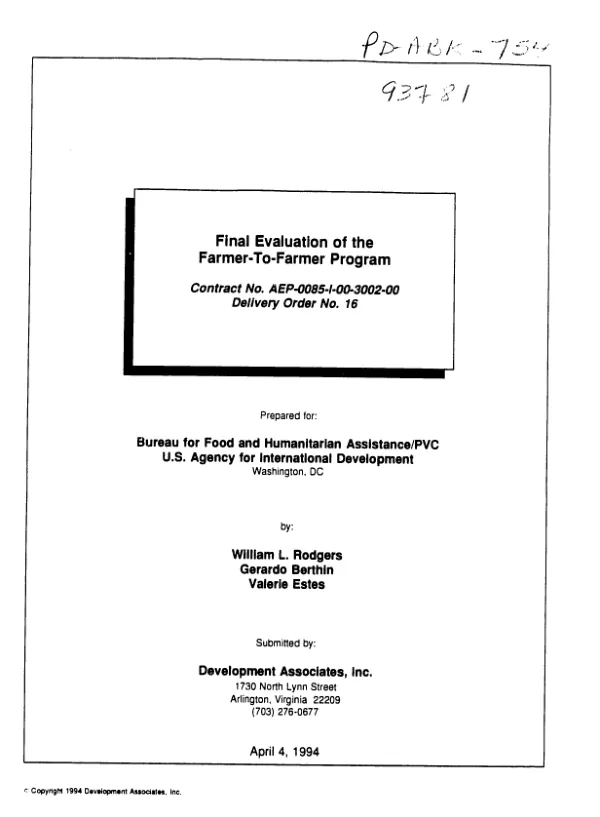
Final evaluation of the farmer-to-farmer program
Final evaluation of the Farmer-to-Farmer (FTF) Program, which uses person-to-person relationships between U.S.
Rodgers, William L.|Berthin, Gerardo|Estes, Valerie · 1994
Sign in to readA free account is required to download.
Abstract
agriculturalists and developing country counterparts as a means of promoting agricultural development and international understanding. The evaluation covers the period since the program's inception in 1985. Currently operating in more than 60 countries in Asia, Africa, Latin America, and Europe, the FTF program utilizes the voluntary services of U.S. farmers, agriculturalists, land grant universities, private businesses, and non-profit farm organizations to meet the needs of host country farmers and farmer organizations in a wide variety of areas, including animal health, field crop cultivation, fruit and vegetable growing, food processing, honeybee and honey production, marketing, agricultural inputs, agricultural extension, and cooperative and farm group management. Implementing agencies include Volunteers in Overseas Cooperative Assistance (VOCA), the National Association of the Partners of the Americas, Winrock International Institute for Agricultural Development, and the National Farmers Union. First and foremost, FTF is a good use of USAID resources. The program provides an important link between the agricultural and agribusiness community in the United States and counterparts in USAID client countries. The evaluation's recommendations for improving the program presuppose that it is fundamentally sound and that it should be continued. The majority of returned volunteers believe in the FTF program and are satisfied with it. They like the direct, person-to-person approach, free of bureaucratic layers between themselves and their clients, whose overall comments on them were complimentary. The volunteers themselves felt that, given the time and resources available, they had adequately addressed the problems put to them. A great majority felt that their work had been useful or even very useful for the client, with most able to cite specific changes for which they had been responsible. On the negative side, despite the complimentary comments made on their work, the volunteers, regardless of the geographic region of their assignment, almost universally complained of a lack of follow-up and feedback. Additionally, some of the implementing agencies are seeking to expand the program beyond their present staff and monitoring capabilities, justifying this by saying that the program is demand driven. With this expansion grows the danger that the program will become another unwieldy and unmanageable operation, more form than substance. Major lessons learned and recommendations are as follows. (1) The core of the FTF program lies in its volunteers. Dedicated, enthusiastic, and highly motivated, these skilled professionals need to feel that their recommendations are acted on or at least followed up on. Implementors must thus take care in choosing counterpart organizations with the capacity to absorb and act upon the TA they receive. (2) With the annual budget standing at $3-4 million, the maximum number of implementors should not be increased and should probably be reduced. Moreover, in light of the undue management burden caused by having the program spread over 60 countries, the number of participating countries should also be substantially reduced. (3) Active Mission support for the program increases the success ratio and sustainability of the in-country projects and the impact of the volunteer's TA. (4) Consecutive visits to a project by the same volunteer increases that project's chances of success. (5) Prospects for sustainability are enhanced by structured short-term, hands-on U.S. training. It is recommended that the implementors establish a Reverse FTF program for training promising host country candidates identified by the volunteers. (6) The project should establish universal impact indicators for inclusion in all contracts and agreements. In a related area, the implementors and USAID should assume greater responsibility in monitoring the impact of FTF-funded projects.
Related documents